
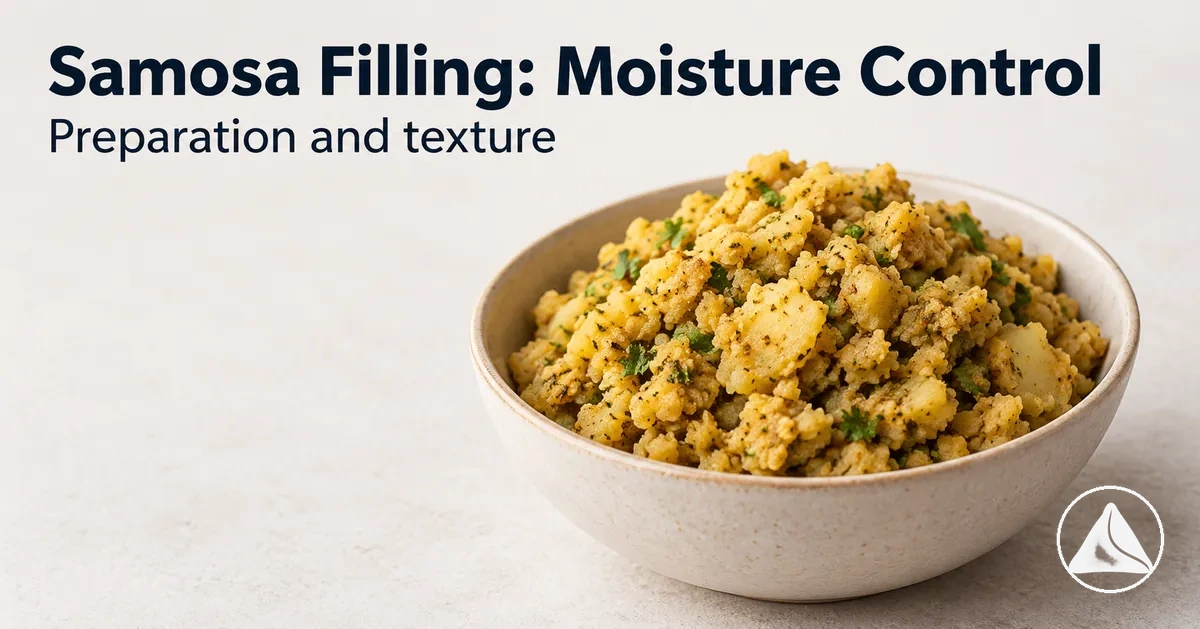
Preparing Samosa Filling for the Right Moisture and Consistency
Prepare samosa filling so it is moist within the ingredients but free of pooled liquid, cohesive enough to hold a spooned mound, and cool enough to handle without noticeable steam. Before sealing, use a portion that leaves clear pastry edges that meet without strain; excess liquid can soften the wrapper, while overfilling can increase the chance of gaps or leakage.
Wrapping readiness
Is your samosa filling ready to wrap?
Confirm these four observable conditions before folding. Tick only the checks your filling and wrapper pass; each condition includes what to do if it fails.
Check the four conditions
These checks cover moisture, cohesion, cooling and portion size. They do not replace safe cooking or food-handling requirements for the ingredients.
Table of Contents
Moisture and Consistency Targets for Samosa Filling
Samosa filling should have no uncontrolled free liquid, enough cohesion to keep its ingredients together, and a consistency that supports easy wrapping.
Moisture and cohesion are the primary attributes because they influence how the filling behaves during portioning and contact with the pastry.
Temperature, particle structure, and shape retention provide supporting readiness cues.
These attributes must work together, since a filling can appear dry but still be too crumbly, pasty, or loose to handle comfortably.
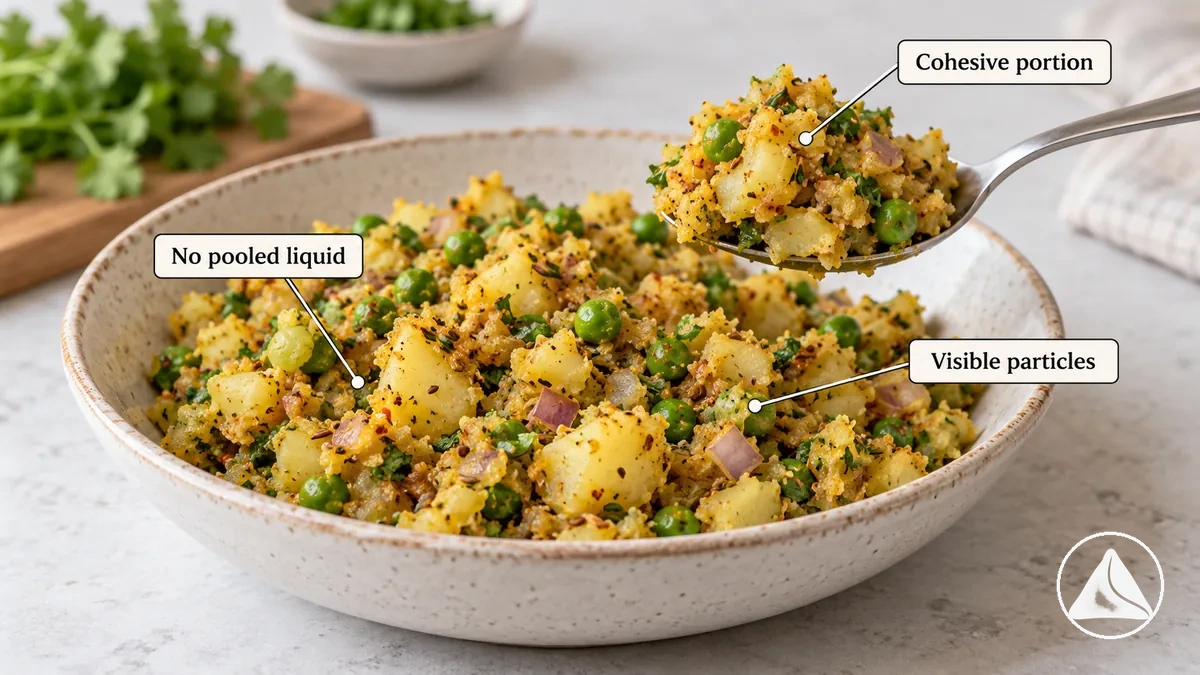
- Free liquid: The filling should have no visible pooled liquid around its ingredients. Contained moisture reduces the chance of liquid directly wetting the pastry during wrapping.
- Cohesion: The ingredients should remain together when a spoonful is lifted or portioned rather than scattering immediately. Adequate cohesion makes the filling easier to handle without requiring a smooth paste.
- Temperature: The filling should be cool enough for comfortable handling without releasing noticeable steam against the pastry. Temperature indicates wrapping readiness rather than defining the filling's moisture or consistency.
- Particle structure: Where the filling contains chopped or mashed ingredients, the pieces should form a manageable mixture without becoming excessively pasty, runny, or difficult to contain. Distinct particles can remain visible while the surrounding mixture provides cohesion.
- Shape retention: A portion should form a loose mound rather than immediately flattening or flowing across the spoon. This stability makes its position easier to control inside the pastry.
The acceptable balance between these attributes depends on ingredient composition and filling type.
A potato-based samosa filling may contain recognizable potato pieces that hold together, while a finely chopped vegetable filling may have a softer structure that remains suitable when its free moisture is contained.
A mixture that holds its shape but remains hot still needs to meet the temperature-readiness condition, just as a cooled mixture must retain sufficient cohesion for portioning.
How Dry Samosa Filling Should Be
Samosa filling should be dry enough to show no free liquid or seepage while remaining cohesive and pleasant to eat.
Here, dryness means controlling loose surface moisture rather than eliminating the internal moisture that keeps the ingredients tender and able to hold together.
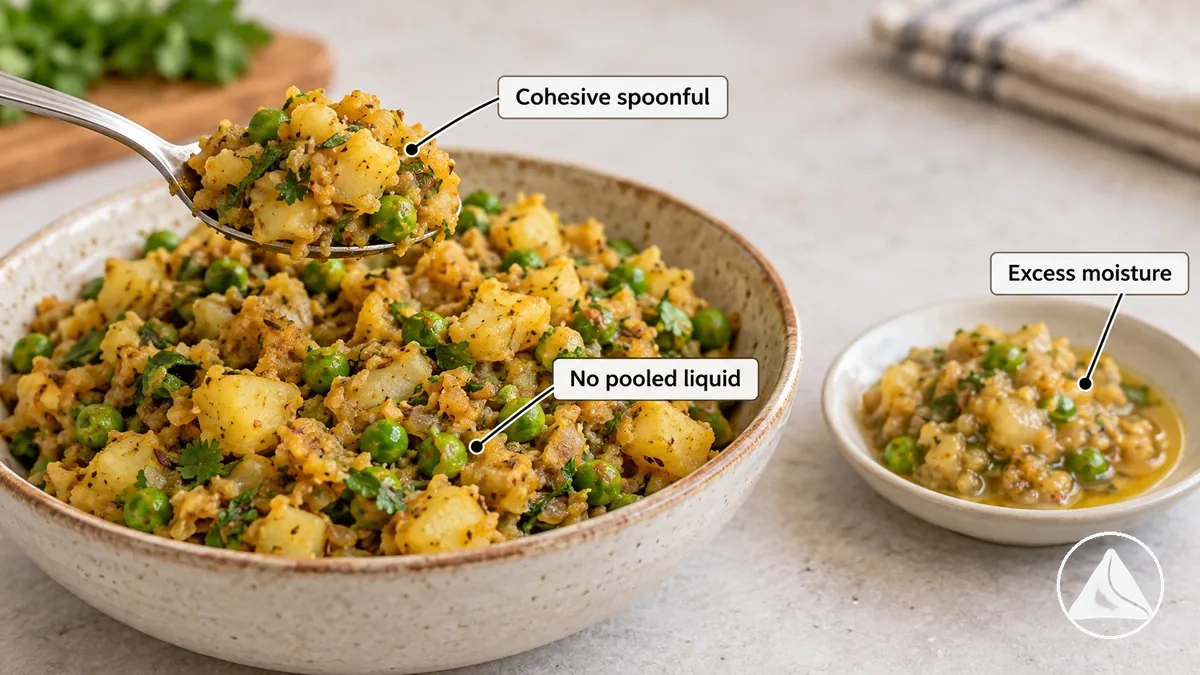
- Still too wet
- Liquid pools, or gentle pressure releases droplets or leaves a wet patch. This moisture can pass into the wrapper and soften it. Drain or reduce free liquid, then check again.
- Ready to portion
- The surface looks lightly moist, but not wet. A potato-based or similarly cohesive spoonful holds a loose mound without seepage when lifted or lightly pressed.
- Too crumbly
- The ingredients scatter or fall apart when lifted, making them harder to contain. Where suitable, lightly mash a little of the cooked mixture to improve cohesion rather than drying it further.
Signs the Filling Is Ready for Wrapping
Samosa filling is ready for wrapping when it is cool enough to handle, holds together when portioned, retains its shape, and shows no new liquid after a short rest.
Temperature, handling stability, shape retention, and resting behaviour must be assessed together because one satisfactory sign does not establish overall readiness.
- Temperature: The samosa filling feels cool enough for comfortable handling and releases no noticeable steam against the pastry. If it remains too hot to handle comfortably, it is not ready for wrapping.
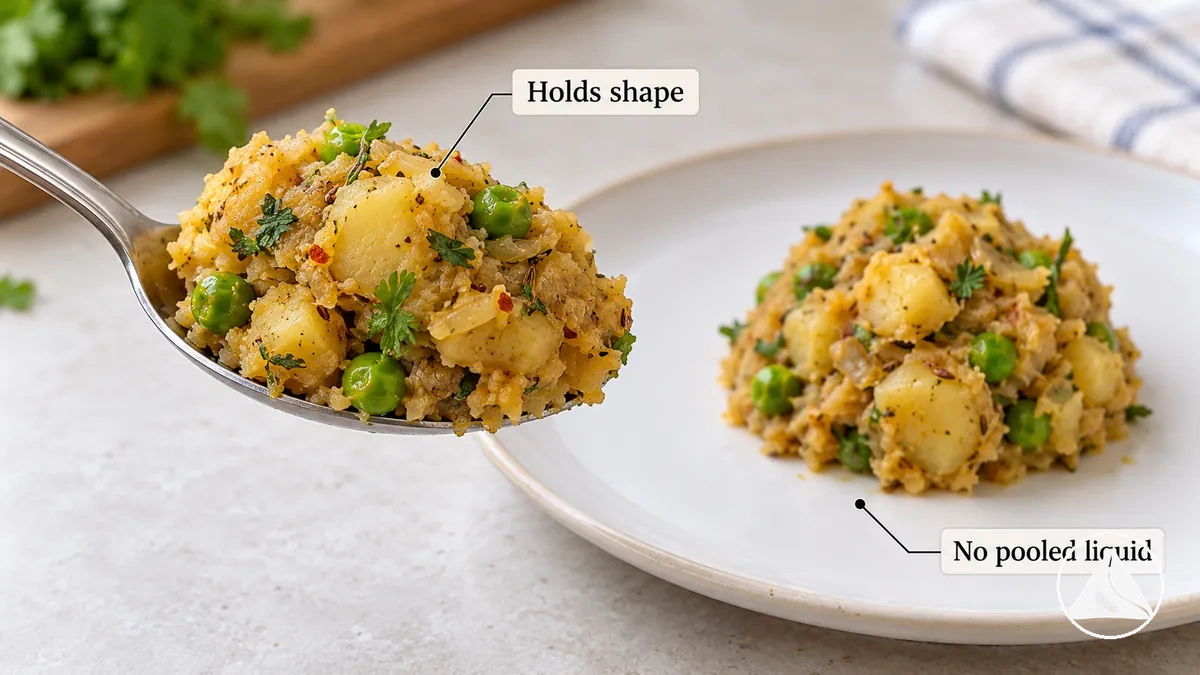
- Portioning behaviour: A spoonful of filling lifts as a cohesive portion without scattering or spreading into a loose mixture. If it falls apart during transfer, its handling stability is insufficient.
- Shape retention: Once portioned, the filling maintains a loose mound rather than immediately flattening or spreading. This supports controlled placement inside the pastry.
- Resting stability: After a short rest, the filling maintains its consistency without new liquid collecting underneath or around the portion. Fresh seepage indicates that moisture stability has not yet been achieved.
A portion that holds together only while compressed but breaks apart when lifted lacks sufficient cohesion for handling.
Similarly, filling that initially retains its shape but releases new liquid after resting has not passed the combined readiness checks.
When all four conditions are satisfied, the samosa filling is ready for wrapping; if any condition fails, the filling needs further preparation before being enclosed in pastry.
What Excess Moisture Does to the Pastry
Excess moisture from samosa filling can transfer into the pastry where the wet filling touches the inner wrapper.
This moisture transfer can soften the pastry at the contact area, particularly when free liquid collects against its surface.
The resulting softening may make that part of the pastry less stable during handling than areas that have not absorbed additional moisture.
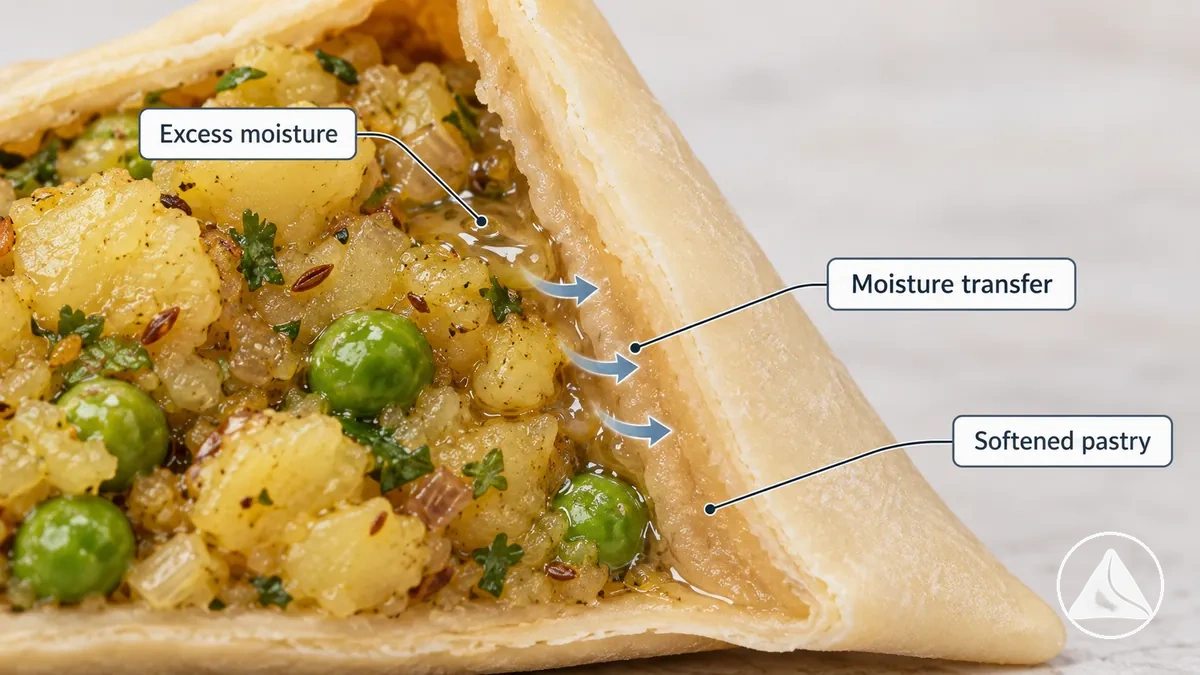
When softened pastry is handled or cooked, the affected area may develop structural weakness, increasing the likelihood of tearing or leakage.
If moisture remains concentrated against the wrapper, it can also contribute to a soggy texture rather than the intended pastry consistency.
However, excess filling moisture is a contributing factor, not a sufficient explanation for every soggy, leaking, or burst samosa.
Dough preparation and cooking conditions can also affect pastry structure and texture independently of filling moisture.
Preparing Samosa Filling to Control Excess Moisture
Samosa filling preparation should control excess moisture by allowing ingredients to release moisture, draining separated liquid where appropriate, and reducing remaining free liquid until the mixture becomes cohesive.
The goal is a stable filling with no pooled liquid that could wet the pastry during wrapping.
Different ingredients release and retain water differently, so a vegetable-based filling may require more moisture reduction than a relatively dry potato mixture.
Each preparation stage should respond to the filling's observed condition rather than a fixed cooking time.
Moisture-rich ingredients may release water as they heat, temporarily making the samosa filling wetter before it begins to thicken.
When liquid separates from the solids, draining can reduce the amount of free water carried into the finished mixture.
If excess liquid remains distributed throughout the filling, cooking uncovered allows evaporation, while occasional stirring exposes wetter areas and supports even reduction.
As moisture decreases, the filling should gradually change from loose and spreading to cohesive and manageable.
The following sequence connects each preparation action to that moisture-state change, with individual stages adapted or skipped when unnecessary.
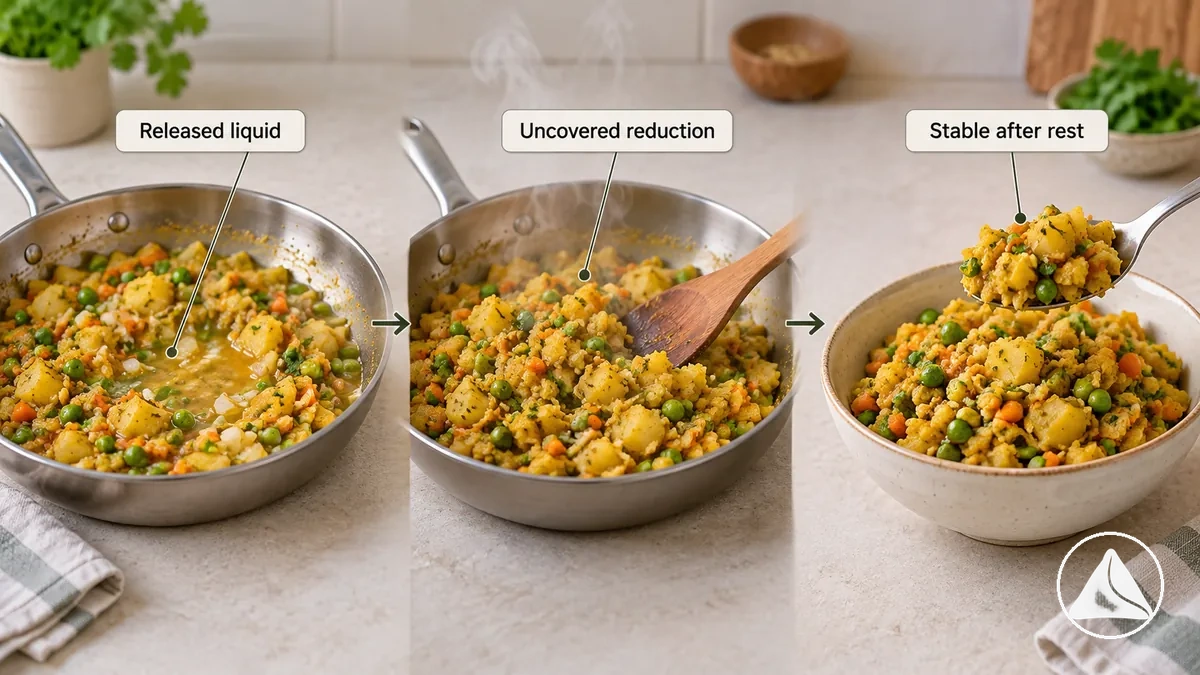
- Allow ingredients to release moisture: During the preparation appropriate to the ingredients, observe whether water collects around the solids. This identifies excess moisture that may need to be drained or reduced before wrapping.
- Drain separated liquid where applicable: If cooked or prepared ingredients are sitting in freely separable liquid, drain the excess water before combining them into the filling. Skip this stage when no drainable liquid is present.
- Reduce remaining free liquid: If the samosa filling is still visibly wet, cook it uncovered with occasional stirring to encourage evaporation. Continue only until liquid stops pooling and the mixture develops a cohesive consistency that can be portioned without spreading.
- Rest and verify the filling: Allow the prepared mixture to rest and settle, then check whether a portion holds together without releasing new liquid. A stable filling should maintain its consistency rather than becoming wet again after resting.
Resting provides an opportunity to identify moisture that was not apparent immediately after cooking or draining.
If fresh liquid collects underneath the filling, further moisture control may be needed; if the mixture remains cohesive with no pooled liquid, additional reduction is unnecessary for wrapping readiness.
The finished state should be stable and manageable without being excessively dry or crumbly.
Raw vs Cooked Filling for Moisture Control
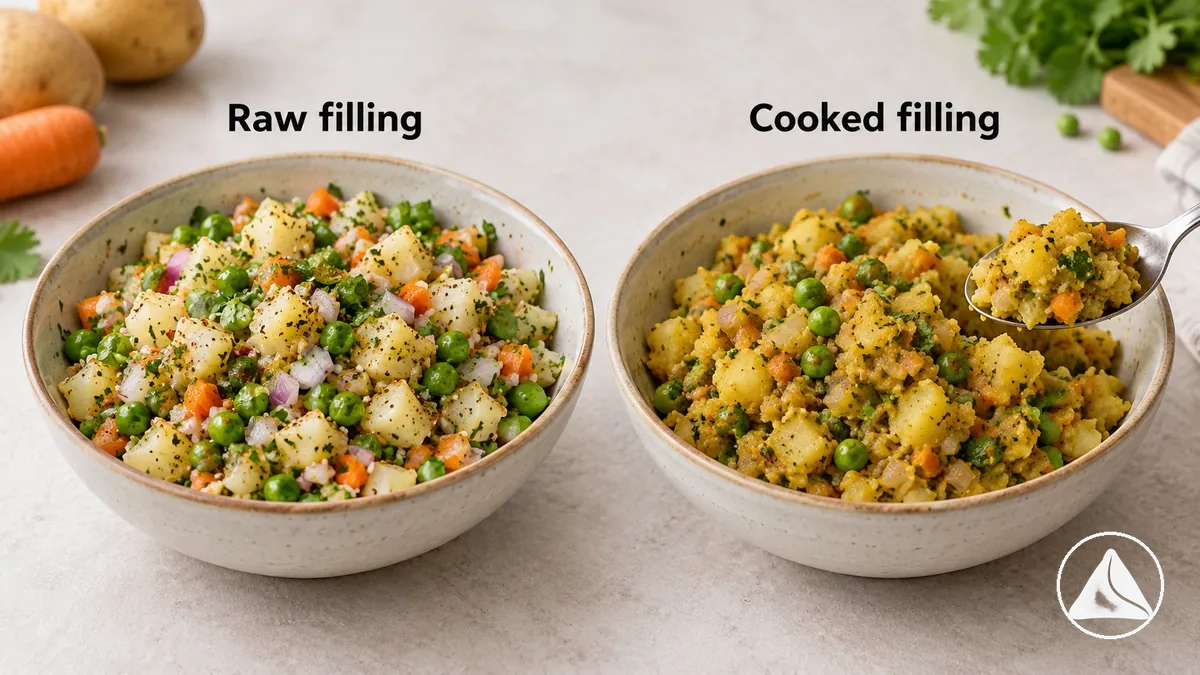
Raw filling and cooked filling differ mainly in when moisture is released and how predictable the filling's consistency is before wrapping.
Raw ingredients may retain water that is released during later cooking, while pre-cooking allows some excess liquid to be identified and reduced before the filling enters the pastry.
The comparison concerns moisture control, consistency predictability, cooling, and wrapping readiness rather than which approach is universally preferable.
Neither filling state alone confirms that the mixture has reached a stable, non-wet condition.
| Criterion | Raw Filling | Cooked Filling | Practical Implication |
|---|---|---|---|
| Moisture release | Water-rich raw ingredients may release moisture while resting or during subsequent heating. | Some ingredient moisture is released during pre-cooking and becomes available for removal. | Moisture released before wrapping is easier to observe and manage than moisture retained within uncooked ingredients. |
| Pre-wrapping moisture control | Visible liquid can be drained, but water held inside raw ingredients may remain until they are heated. | Released liquid can be drained or reduced through evaporation before wrapping. | Pre-cooking provides an additional opportunity for moisture reduction when ingredients release substantial water. |
| Consistency predictability | A mixture may initially hold together but become wetter as its ingredients release more moisture. | The mixture's consistency can be evaluated after cooking and resting, although further seepage remains possible. | Observed stability provides a more useful readiness signal than the raw or cooked classification alone. |
| Cooling | No cooling from a full pre-cooking stage is needed, provided the ingredients are already suitable for handling. | The filling needs to cool sufficiently after cooking before being placed against the pastry. | Pre-cooking adds a cooling requirement, while both approaches still need a suitable handling temperature. |
| Ingredient dependence | Firm, relatively low-moisture ingredients may behave differently from chopped vegetables that release considerable water. | Water-rich ingredients may require more reduction, while starch-rich mixtures may hold moisture within a cohesive texture. | The appropriate approach depends on the ingredients' moisture behaviour and the filling state required for wrapping. |
Ingredient type and preparation method determine how much practical difference exists between raw and cooked filling.
For example, chopped leafy vegetables or onions may release noticeable liquid during resting or heating, whereas a potato-based mixture may retain moisture within a more cohesive structure.
A raw filling can be suitable when its ingredients remain manageable without free liquid, while a cooked filling can still be unsuitable if liquid collects after resting.
Wrapping readiness therefore depends on the filling's observed moisture and stability before enclosure, not on choosing raw or cooked ingredients as a universal rule. Raw or pre-cooked is not a food-safety classification: ingredients that require cooking, particularly meat, still need to be cooked safely before serving.
Reducing Free Liquid During Cooking
Reducing free liquid during cooking means allowing excess moisture to evaporate while keeping the samosa filling cohesive and manageable.
The aim is no visible pooled liquid while retaining enough moisture for cohesion—not a completely dried-out mixture.
- Let the ingredients release moisture. Allow water-rich ingredients to soften and release their initial liquid before deciding how much reduction is needed.
- Evaporate only when liquid collects. If water pools around the solids, cook uncovered at a suitable heat. Stir periodically to expose wetter areas, distribute moisture and prevent sticking.
- Recheck the spoonful. When liquid is no longer visible, stir and lift a portion. It should remain cohesive without new liquid collecting underneath or around it.
Stop reducing once the filling is stable. A spoonful that crumbles and breaks apart may be over-dried even when no free liquid remains; further evaporation is not the right adjustment.
Cooling Samosa Filling Before Wrapping
Cooked samosa filling should cool before wrapping so residual heat and steam can dissipate without adding avoidable moisture to the pastry.
Wrapping while the filling is still steaming can create condensation where the filling contacts the wrapper, potentially softening the pastry.
The required cooling time depends on batch size, container depth, and ambient conditions, so the filling's temperature and moisture state are more useful than a fixed duration.
- While cooling
- Let steam escape, spreading the cooked filling into a shallower layer where practical to help heat dissipate.
- Watch for renewed moisture
- Look for condensation on nearby surfaces or fresh wetness settling in the mixture. Stir or lift a small portion and check again for collected liquid.
- Ready for the wrapper
- The filling is comfortable to handle, no longer steaming and still cohesive, with no newly pooled liquid.
Filling Quantity and Overfilling
Filling quantity should balance enough stuffing to give a samosa its intended shape with sufficient unfilled pastry for secure closure.
The appropriate portion depends on wrapper size, filling density, and the sealing margin needed around the edges.
Overfilling occurs when the filling amount exceeds the wrapper's usable capacity, making the pastry difficult to bring together without pressure.
These factors interact because the same portion can fit comfortably inside one wrapper but crowd another.
Wrapper capacity determines the available space, while filling density affects how much volume a portion occupies.
A compact mixture may take up less room than a loosely packed filling of similar weight, so portion weight alone does not establish suitability.
The remaining sealing margin is the practical boundary because it determines whether the pastry edges can meet without being stretched or obstructed.
The following criteria explain how each factor influences the filling amount.
- Wrapper size: A smaller wrapper has less usable capacity than a larger one. Adjust the filling portion to the space available after allowing for the pastry needed for closure.
- Filling density: Dense, cohesive filling may occupy less space than a loose mixture of similar weight. Judge the portion by its actual volume and shape inside the wrapper rather than by weight alone.
- Sealing margin: The pastry edges should remain free of filling and have enough space to meet without excessive pressure. If the portion crowds this margin, reduce the filling amount before closure.
An underfilled samosa may lack a defined shape because the filling does not occupy enough of the wrapper's available space.
An appropriately filled samosa holds its shape while retaining a clear sealing margin, whereas an overfilled one may bulge and resist closure.
The suitable filling quantity is therefore the portion that fits within the wrapper's capacity without forcing the pastry edges together, rather than a single amount applied to every samosa size.
How Much Filling to Use per Samosa
Use enough filling to give each samosa a well-filled shape while leaving sufficient pastry sealing margin for clean closure.
The filling amount per samosa depends on samosa size, wrapper size and filling density, so a single tablespoon or gram measurement is not suitable for every variation.
Start with a portion that occupies the wrapper comfortably without crowding the edges.
Filling density also affects spooned volume, so check the portion inside the wrapper and reduce it if the filling crowds the sealing margin.
Calibrate the filling amount using the first samosa, then maintain that portion only when the wrapper size and filling consistency remain comparable.
How Overfilling Affects Sealing and Leakage
Overfilling reduces the available sealing margin and increases pressure against the pastry edges, making a samosa more difficult to close securely.
- The wrapper becomes crowded. Too much filling pushes the pastry outward and leaves too little unfilled edge area for closure.
- The seam is strained. Forcing the edges together may stretch the pastry, leave the seam under tension or close it unevenly.
- Gaps become more likely. A strained seam may separate during handling or cooking and contribute to leakage if an opening forms.
By contrast, a correctly portioned filling gives the samosa shape while leaving sufficient space for the edges to meet without excessive pressure.
Overfilling is one contributing factor, not the only cause of opening or leakage; sealing technique and other conditions also affect whether a samosa stays closed.