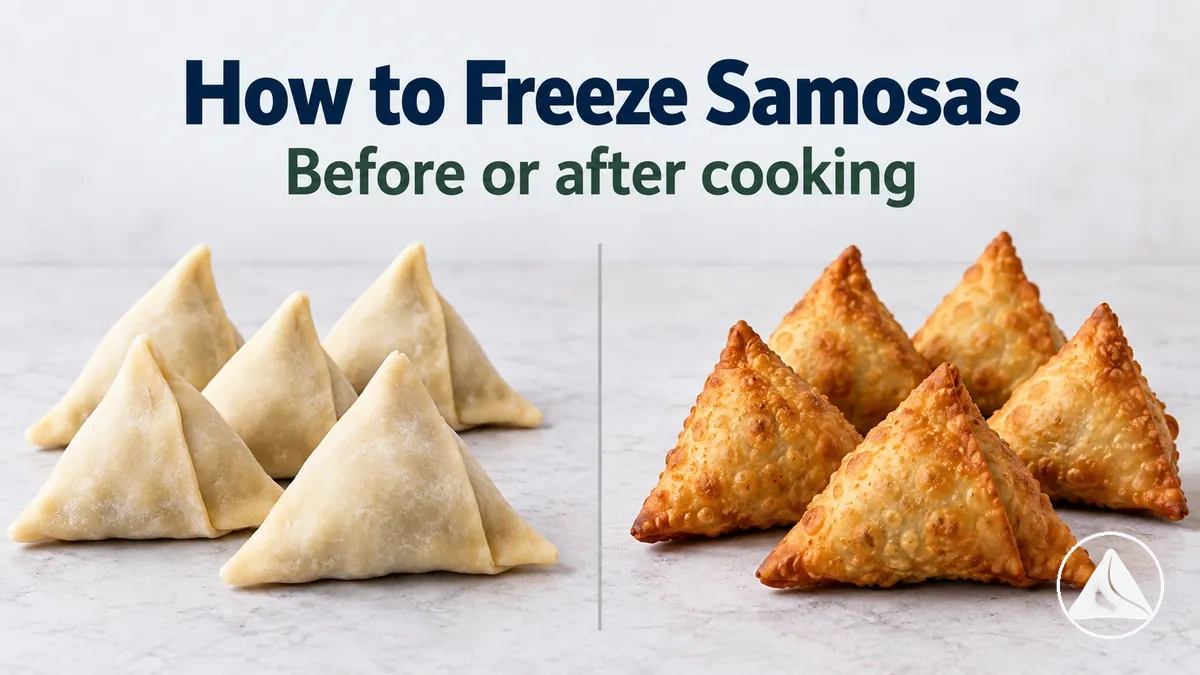
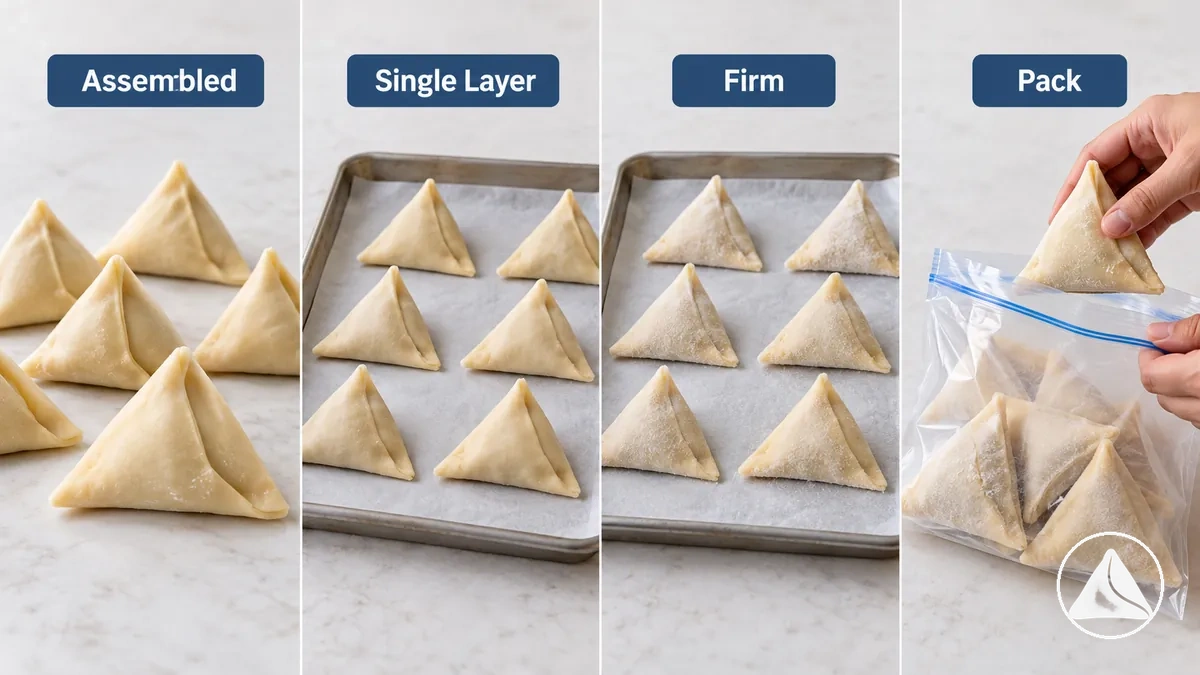
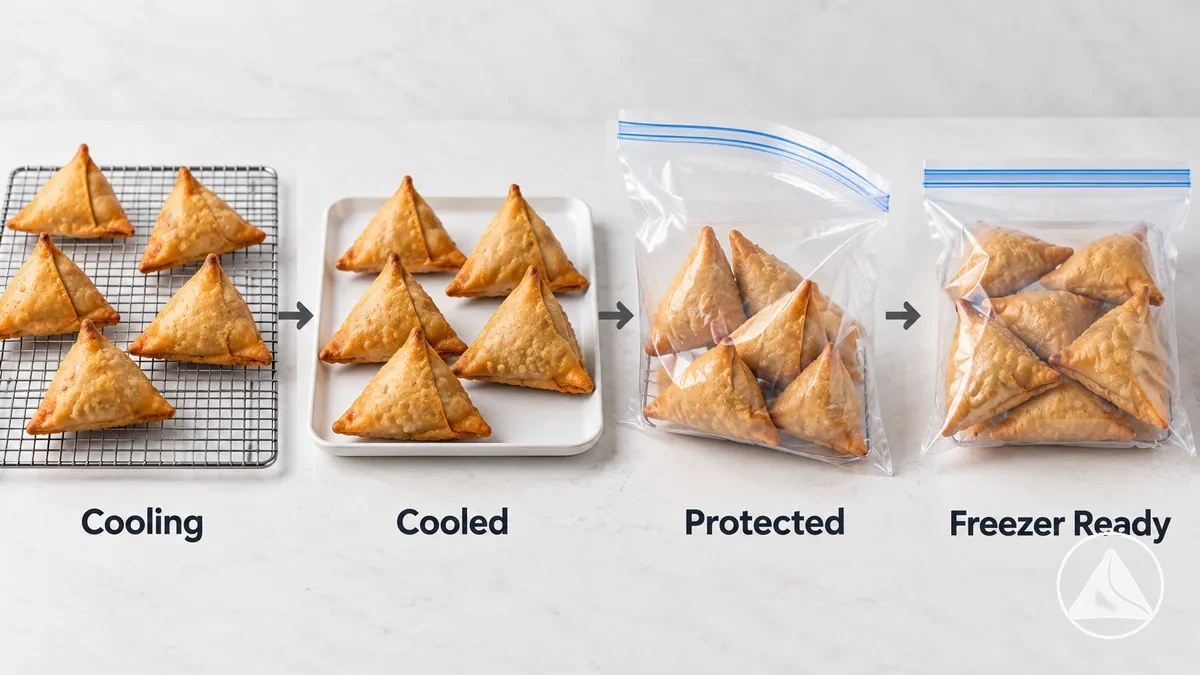
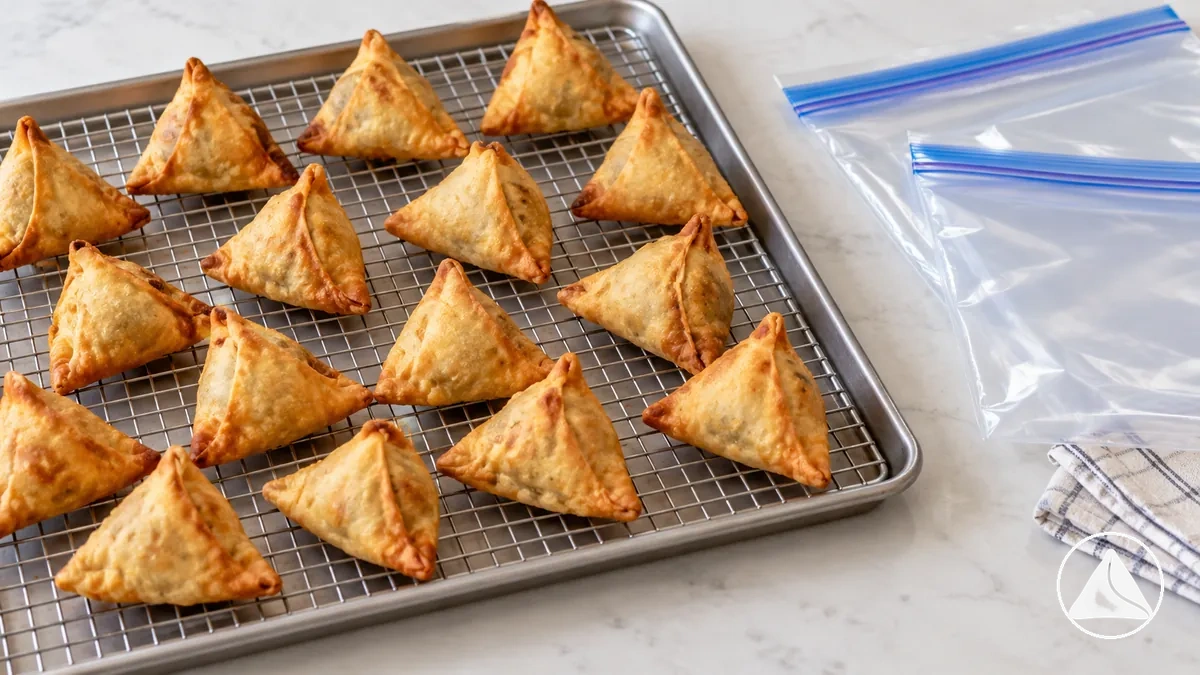
You can freeze samosas before or after cooking. For uncooked samosas, tray-freeze the assembled pieces separately until firm, then seal them in freezer packaging; for cooked samosas, cool and chill them promptly before packing. Store either type at −18 °C or colder, and thaw only when the later cooking or reheating instructions require it.
FREEZING METHODS AT A GLANCE
Choose when you want to do the cooking
Both options work. Compare the same three decisions for each freezing stage.
Freeze before cooking
Uncooked samosas
Best suited to
Assembling now and doing the final cooking later.
Freezing sequence
Seal the pastry, tray-freeze separately until firm, then portion and pack.
After freezing
Cook from frozen when the recipe or product method allows; cook the filling thoroughly.
Freezer-safe packaging, minimal excess air and a date label
Thawing rule
Follow the method; thaw perishable fillings in the fridge if thawing is required
Storage-quality guide: 3–4 months is a general prepared-food benchmark, not a tested samosa-specific use-by date.
Table of Contents⌄
Choose Whether to Freeze Samosas Before or After Cooking
Uncooked samosas leave the cooking stage for later; cooked samosas move that work earlier and need prompt cooling before freezing. Neither is always preferable: choose according to serving-time convenience, handling stability and the pastry texture you want.
Both are established approaches. Thumbs Up Foods publishes separate instructions for uncooked frozen samosas and pre-cooked frozen samosas, showing why the later cooking or reheating method matters.
Preparation effort: If you freeze before cooking, preparation stops after the samosas are assembled and ready for freezing, so the cooking stage remains for later. If you freeze after cooking, more work is completed upfront before the samosas are cooled and packaged.
Later convenience: Cooked samosas typically need reheating rather than a full cooking stage, whereas uncooked samosas still require cooking. Freezing after cooking can therefore suit situations where reducing preparation at serving time matters more than front-loading the work.
Handling stability: Uncooked samosas may stick together or lose shape if packed while still soft, so they can require an initial separated freeze before bulk packaging. Cooked samosas may instead need protection from crushing when the finished pastry is fragile.
Texture sensitivity: The preferable freezing stage can depend on the pastry and intended cooking method. Thumbs Up Foods advises freezing filled samosas made with its wrappers before frying when a crisp wrapper is desired, but that guidance is product-specific rather than a universal rule for every samosa.
If you are assembling samosas now and want to finish cooking later, freeze them uncooked. If they are already cooked and easy serving is the priority, chill and freeze the cooked samosas.
How to Freeze Uncooked Samosas
Start with filled, shaped and securely sealed uncooked samosas. Keep their exterior dry, freeze them in a separated single layer, then transfer them to freezer-safe bags or containers only when the pieces are firm and lift without deforming.
There is no single tray-freezing time: samosa size and freezer performance affect when each piece becomes solid enough to handle. Mamta's Kitchen also describes protective airtight-container storage for frozen uncooked samosas.
Check the assembled samosas. Make sure the uncooked samosas are securely sealed and have a dry exterior before they go into the freezer.
Arrange them in a single layer. Place the uncooked samosas separately on a tray so they begin freezing without being bulk-packed together.
Tray-freeze until firm. Keep the samosas in the initial freeze until each piece is firm enough to hold its shape during handling.
Verify before transfer. Check that each samosa can be lifted individually without soft surfaces pressing together or the pastry deforming.
Transfer to freezer packaging. Once firm, move the samosas into suitable freezer packaging and close it securely for longer frozen storage.
Before packing, check that individual samosas can be lifted separately without compressing soft pastry; firm, intact pieces can then be portioned for frozen storage.
Tray-Freeze Uncooked Samosas to Prevent Sticking
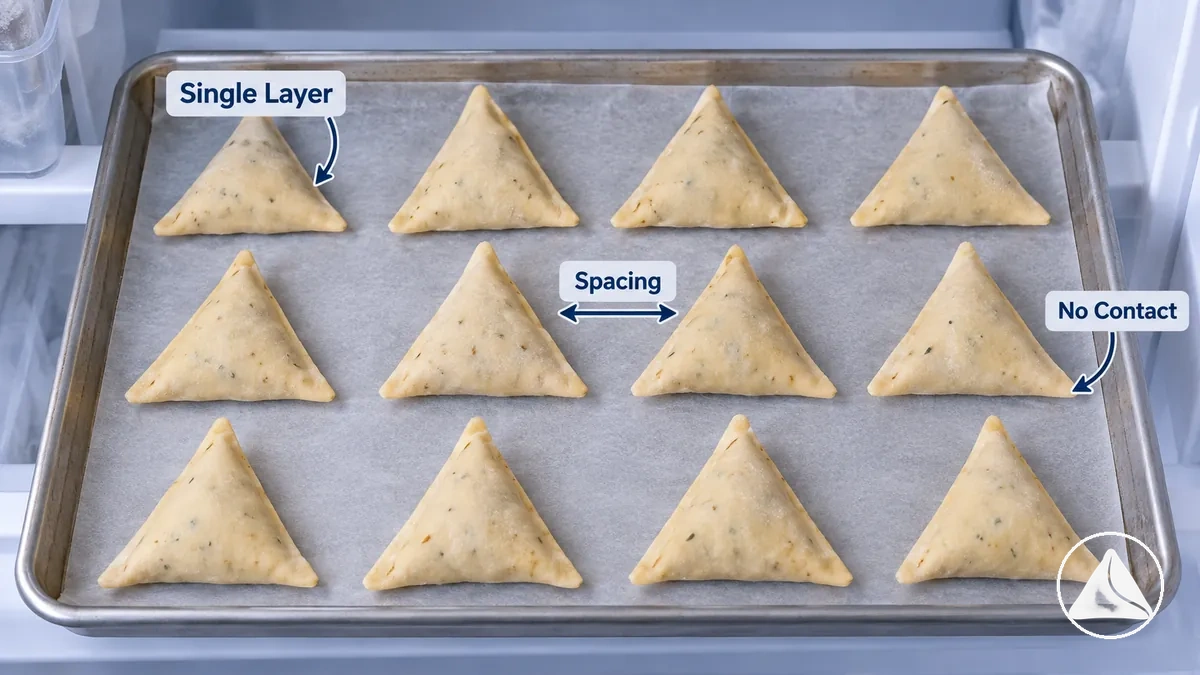
Tray-freeze in one layer with visible gaps until every uncooked samosa is firm enough to lift on its own. Touching or stacking soft pastries can make them stick or distort when separated.
Mamta's Kitchen likewise recommends spreading samosas on a tray before placing them close together in a bag or box. The test for moving them is firmness and individual separation, not an arbitrary number of minutes.
Space the samosas. Place the uncooked samosas on the tray with visible gaps so their sides and edges do not touch.
Keep one layer. Position every samosa directly on the tray without stacking or overlapping pieces.
Freeze until firm. Leave the tray in the freezer until each samosa is firm enough to hold its shape during handling.
Check separation. Confirm that the samosas lift individually without sticking together before moving them from the tray.
Tray-freezing is the separation stage; protective storage packaging comes afterwards, once the pastry keeps its shape during transfer.
Pack Uncooked Samosas After They Are Frozen Solid
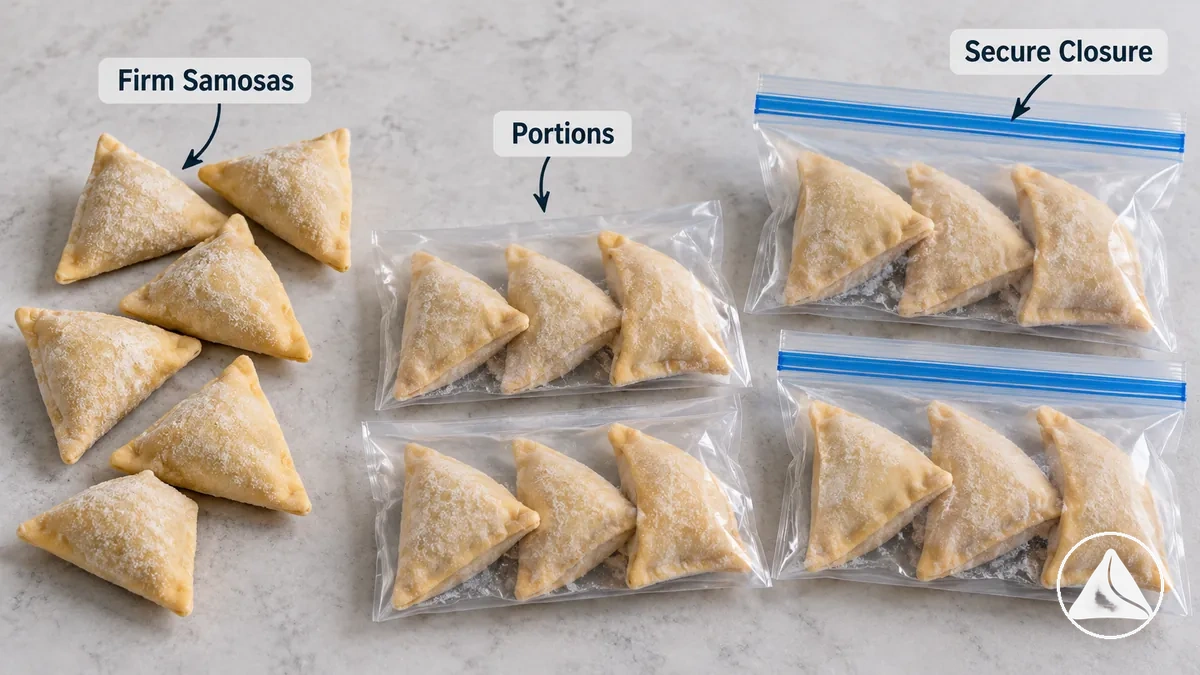
Once uncooked samosas are frozen solid and individually removable, move them from the tray into protective freezer packaging. Petite Paprika describes this tray-to-freezer-bag sequence for assembled samosas.
Portioning lets you take out only what you need. Limit excess air to reduce drying, and use a secure closure and enough physical protection to avoid crushed edges.
Divide the firm samosas into portions. Group the frozen solid samosas according to the quantities you expect to remove at one time.
Protect separation where needed. Keep closely packed pieces or layers divided with a freezer-safe barrier so individual samosas remain easier to remove.
Limit excess air. Arrange the portions in suitable freezer packaging and press out unnecessary air without crushing the samosas.
Secure the closure. Close the freezer bag or container fully so the frozen samosas remain protected inside the packaging.
Add the date. Mark the packaging with the freezing date so each portion can be identified without reopening it.
Properly packed samosas should remain easy to remove in portions without forcing frozen pastries apart.
How to Freeze Cooked Samosas
For cooked samosas, cool promptly, chill and then pack so the pastry is no longer hot or releasing steam when it is sealed. Avoid prolonged room-temperature cooling, particularly when the filling contains meat, dairy or other perishable ingredients.
Once chilled, arrange the pieces so crisp or fragile pastry is not compressed; package them with minimal excess air and a secure closure.
Sealing warm pastries traps steam that can condense and soften the crust. Health Victoria also advises against putting hot cooked food straight into a freezer because it can warm nearby foods; rapid cooling followed by refrigeration resolves both concerns.
Cool promptly and chill. Spread out the cooked samosas briefly to release steam, then refrigerate them promptly if they are still warm; do not leave perishable fillings on the bench for prolonged cooling.
Check the surface condition. If visible surface moisture remains, allow it to dissipate before enclosing the samosas in freezer packaging.
Arrange and protect the samosas. Position the cooled pieces so fragile pastry is not compressed or crushed during packing.
Package the samosas. Place them in suitable freezer packaging and close it securely once the cooling and surface-moisture conditions are satisfied.
Transfer the package to the freezer. Place the securely packaged cooked samosas in the freezer.
Transfer the securely packaged samosas to the freezer promptly once they are chilled and protected.
Cool Cooked Samosas Completely Before Freezing
Cooked samosas need to be cooled safely before airtight freezer packing. Warm pastry releases steam inside sealed packaging, creating condensation that can soften the crust; Samosa Shack likewise warns against sealing cooked samosas while warm.
Judge packaging readiness from the condition of the pastry, not a fixed cooling time. Size, batch quantity, room conditions and cooking method all affect the cooling rate.
Pack Cooked Samosas for Freezing
Divide fully chilled cooked samosas into serving portions and use freezer-safe packaging that limits air exposure without crushing fragile pastry. Closely packed pieces may need a divider or extra support.
Remove excess air gently, close the container or bag securely, and label the freezing date so the batch can be identified without opening it.
Portion the cooked samosas. Group the completely cooled samosas into quantities that can be removed together later.
Protect fragile pieces. Add separation or supportive packing where needed so closely packed samosas are less likely to be crushed.
Remove excess air. Reduce unnecessary air around the portions without pressing hard enough to damage the pastry.
Close the freezer packaging securely. Seal the freezer bag or container fully so the portions remain enclosed and protected.
Add the date. Mark the freezer packaging with the freezing date so the packed batch can be identified without reopening it.
Portions should be easy to remove later without forcing fragile frozen pieces apart.
How Long Samosas Can Stay Frozen
For storage planning, separate preferred eating quality from safe frozen storage. A quality guide is not a use-by date.
Quality planning
About 3–4 months is a general prepared-food benchmark at −18 °C. It comes from USDA guidance for frozen dinners and entrées; it is not a tested shelf life for every samosa.
Safety condition
Keep food continuously frozen at −18 °C or colder. Freezing stops microbial growth but does not correct unsafe preparation, cooling or handling before freezing.
The useful quality window depends on packaging integrity, freezer stability, preparation state and moisture exposure. Food Standards Australia New Zealand advises keeping frozen food hard frozen and its packaging undamaged; USDA guidance also links poor packaging and extended storage with drying.
Freezer temperature: Temperature swings or partial thawing can reduce quality and invalidate an assumption of steady −18 °C storage.
Packaging integrity: Torn or poorly closed bags admit air and increase the chance of dehydration and freezer burn.
Cooked or uncooked state: Do not assume separate exact month limits for the two states; choose the next batch to use by its freezing date and condition.
Moisture exposure: Condensation and air exchange can harm pastry texture; keep the pieces dry enough to pack without trapped moisture.
Frozen samosas can remain stored beyond the general quality guide if they have been handled and frozen safely, but flavour and pastry texture may deteriorate. Label each batch and use older portions first.
When Frozen Samosas Need Thawing Before Cooking
Frozen samosas do not always need thawing. Whether they can be cooked or reheated directly from frozen depends on their preparation state, the selected method and the recipe or product directions.
Thumbs Up Foods supplies direct-from-frozen methods for uncooked and pre-cooked samosas, while Taza Foods gives a from-frozen air-fryer method. These are preparation-specific examples, not rules for all fillings, wrappers and appliances.
Preparation state: An uncooked samosa still needs full cooking; a cooked one needs thorough reheating. Follow the instructions intended for that state.
Frozen firmness: Intact, firm pastry and seams may be easier to handle directly from frozen when the method supports it.
Cooking method: Direct-from-frozen frying, baking and air-frying are all possible for some samosas, but time and temperature instructions must match the preparation.
Handling risk: Thawing can soften pastry and weaken seams, increasing sticking or leakage in some products; do not thaw merely out of habit.
What the method-specific examples show
Method
Direct-from-frozen example
Condition
Deep-frying
Thumbs Up Foods instructs its uncooked frozen samosas to be deep-fried without thawing first.
Use directions that explicitly permit frozen pastry; avoid assuming all fillings cook at the same rate.
Oven baking
Thumbs Up Foods provides oven directions for its uncooked and pre-cooked frozen samosas without a thawing step.
Use the instructions for the correct preparation state and heat the centre thoroughly.
Air-frying
Taza Foods directs its frozen samosas into the air fryer and cautions that thawing may soften pastry and allow filling to leak.
Use product- or recipe-specific time and temperature settings.
If thawing is required for a samosa with a perishable filling, thaw in the refrigerator, not on the kitchen bench, and then cook or reheat thoroughly.
The deciding rule is the specific preparation and cooking method: cook from frozen when its directions support that approach; otherwise use the stated thawing instructions.