
Diagnosing Why Samosas Open or Burst While Frying
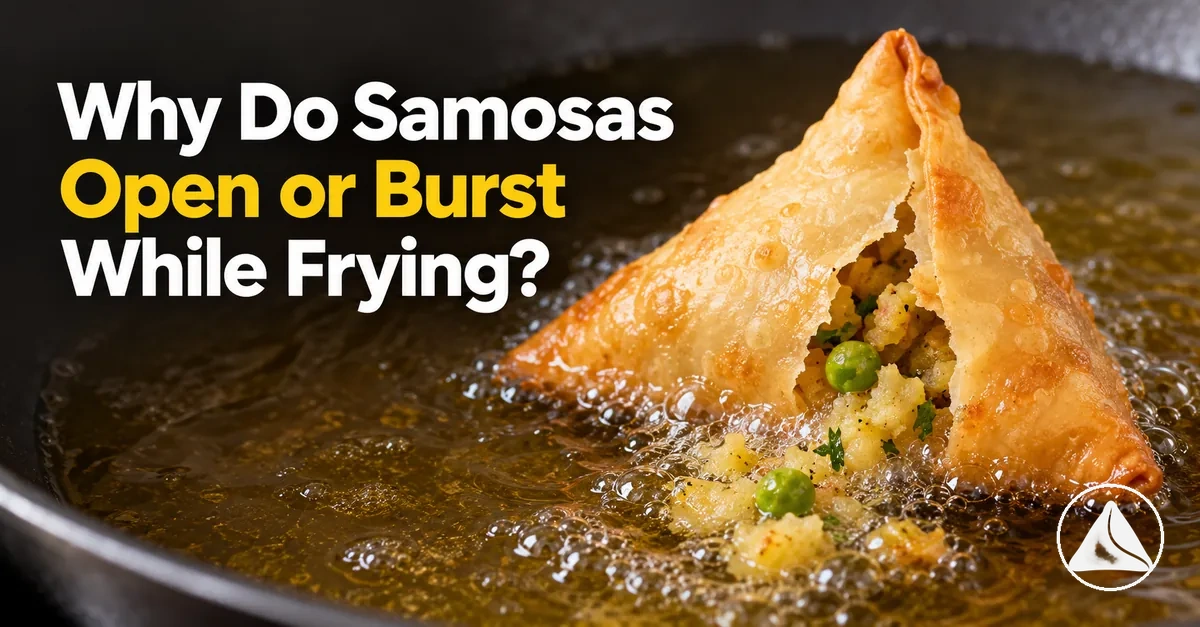
Samosas open or burst during frying when a poorly sealed seam separates or a weak part of the pastry splits as the casing heats and expands. Start with the failure location—along the seam or through the pastry—then check for free liquid in the filling, overfilling, thin or torn pastry, and unusually rapid puffing. These clues suggest what to correct, but no single sign proves the cause.
Diagnose the failure pattern
What should you check first?
Match where the samosa opened with any extra clues you noticed. This guide suggests likely contributors to inspect and a practical next check; it cannot establish a cause from one observation.
Your next check
Choose a failure pattern and any supporting clues, then select “Show what to inspect”. Start by locating the first opening if you are unsure where the filling escaped.
A seam opening, pastry split and filling leak describe different observations; filling leakage can accompany either type of opening. Compare several clues and change one plausible factor at a time in the next batch.
Table of Contents
What Samosa Opening, Splitting, and Filling Leakage Reveal
The failure location and pattern of a samosa opening during frying can help narrow the likely cause, but neither confirms it on its own.
Seam opening suggests a possible sealing weakness, a pastry split points towards a vulnerable area of the casing, and filling leakage indicates that the contents have escaped through an opening in either location.
A seam opening follows the joined pastry edges, whereas a pastry split crosses the casing away from that seam.
Filling leakage may accompany either failure, so the point where the filling escapes is an important visible sign to inspect.
The illustrated examples distinguish these failure locations, while the diagnostic comparison connects each interpretation with a specific next check rather than a final diagnosis.
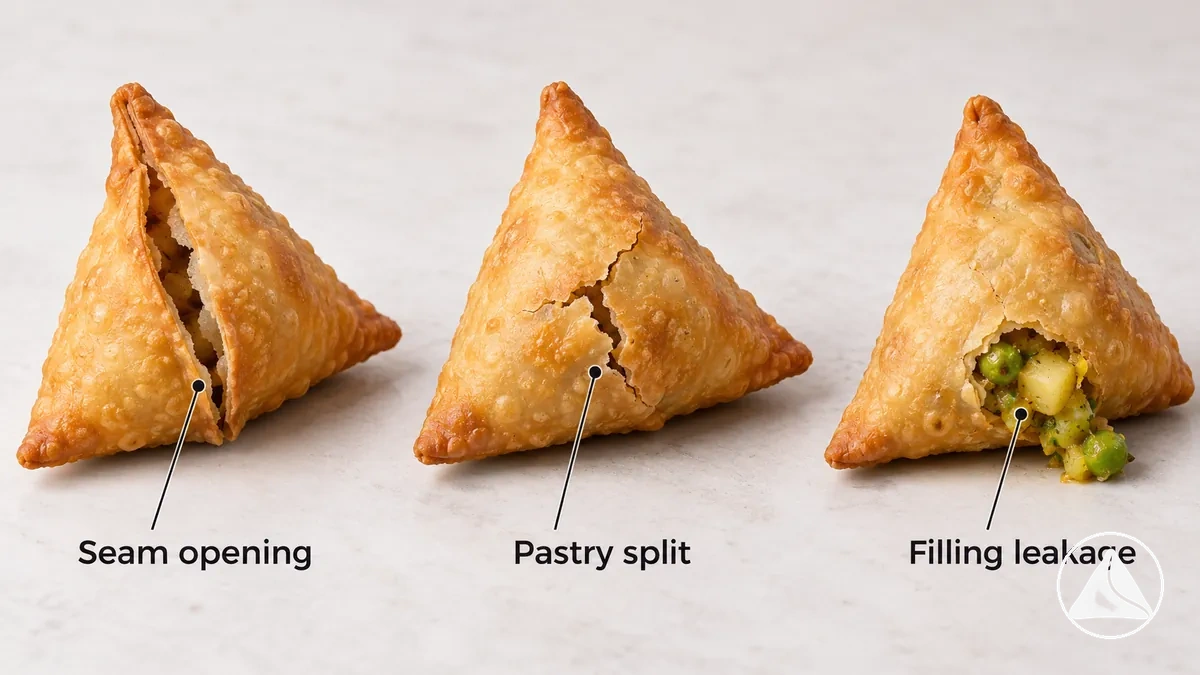
| Observed Failure | What It May Suggest | What to Inspect Next |
|---|---|---|
| Seam opening | The joined pastry edges may have insufficient adhesion or an incomplete seal. | Check whether the separation follows the original seam and whether the joined edges appear loosely bonded or partially unsealed. |
| Pastry splitting | A thin, stretched, uneven, or previously damaged pastry area may have formed a weak point. | Inspect the tear for noticeably thin areas or existing damage, and check whether the surrounding seam remains intact. |
| Filling leakage | Filling has escaped through a separated seam or pastry tear; excess filling moisture or tightly packed contents may contribute. | Locate the opening where the filling escaped, then inspect the filling for visible free liquid or excessive packing against the pastry. |
Why Samosas Open or Burst in the Oil
Samosas can open or burst during frying when a weak seal or vulnerable pastry cannot withstand internal expansion and frying stress.
Opening or bursting therefore often reflects interacting conditions rather than one independently sufficient cause.
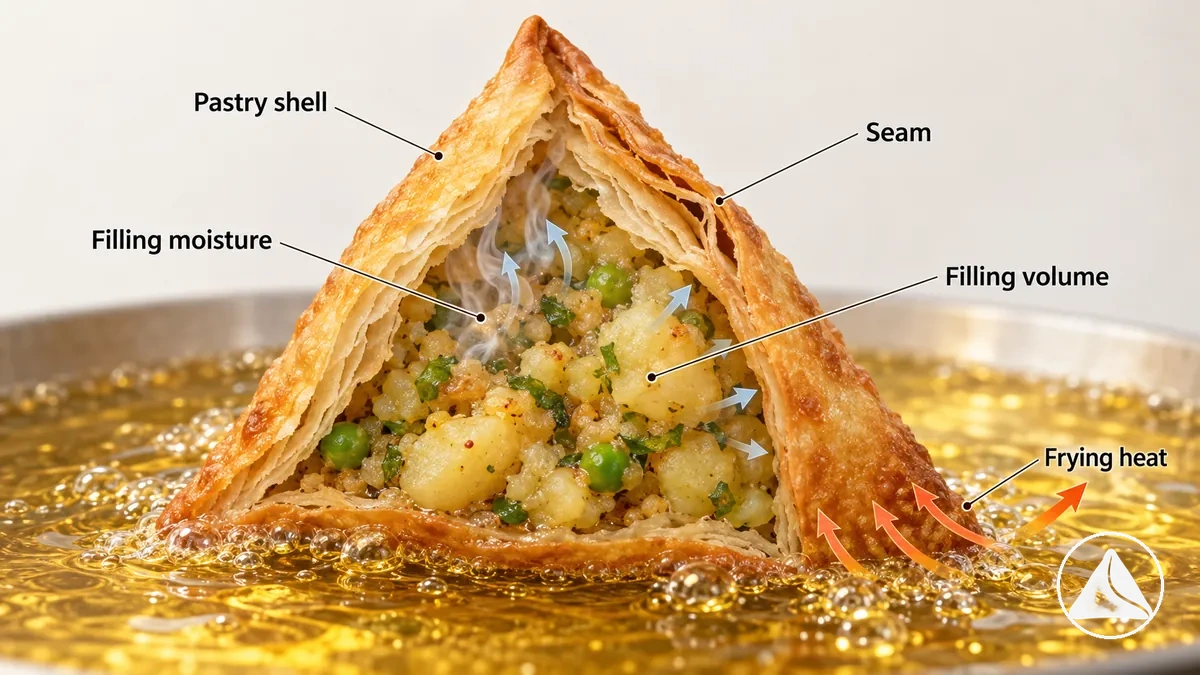
Four conditions that can interact
- Seam and pastry integrity
- Weak adhesion at the join or a thin, stretched or torn patch can determine where an opening begins.
- Filling moisture
- Visible free liquid can dampen the inner pastry; moisture that heats into steam may increase stress at an existing weakness.
- Filling volume
- Tightly packed filling leaves less room to overlap the edges securely and may push outward on the closure.
- Frying heat
- Excessive heat may intensify expansion, but bubbling by itself does not establish an overly high oil temperature.
These factors are possible contributors, not four independent diagnoses. Inspect the seam, filling, pastry and frying behaviour together.
Wet Filling Adds Steam and Moisture Inside the Samosa
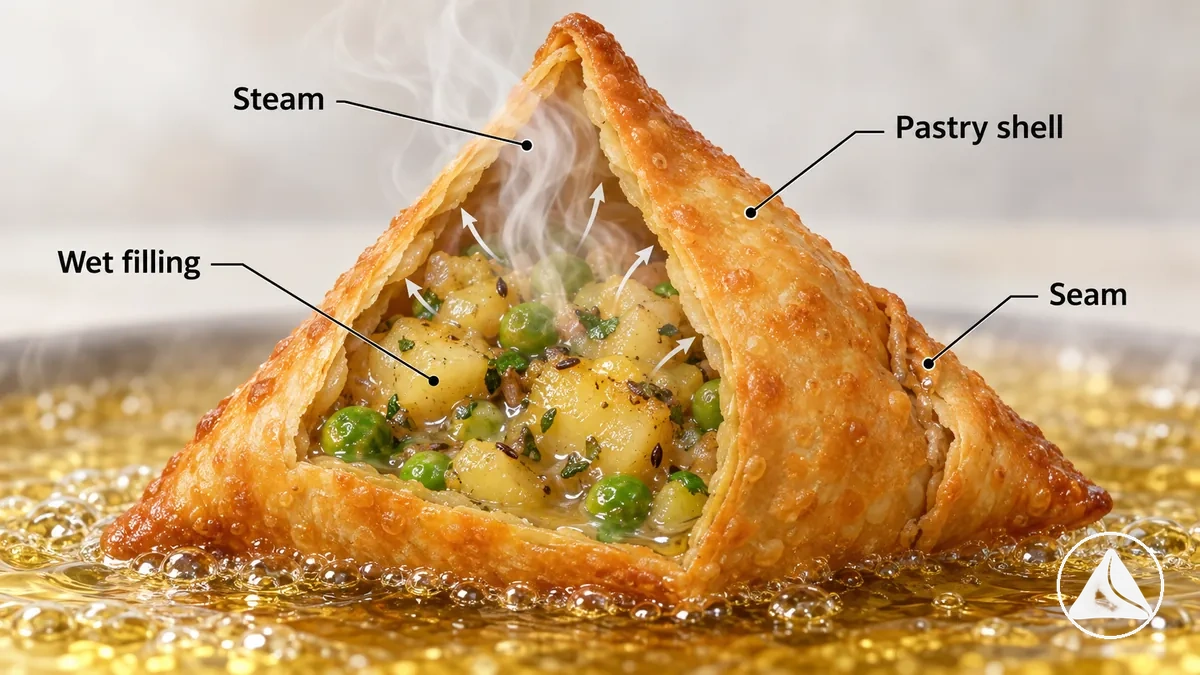
Excess moisture in samosa filling can generate additional steam as the filling heats during frying, increasing pressure against the pastry and seam.
If the seal is weak or the pastry already has a vulnerable area, this internal stress may contribute to the samosa opening or bursting and allow the filling to leak.
Distinguish moist filling from excess free liquid
- Moist, without pooling liquid
- The ingredients hold together and do not release visible free liquid. Excess moisture is less strongly indicated by appearance alone.
- Excess free liquid
- Liquid pools in the pan or around the ingredients. It may soften the pastry from inside and contribute to additional steam during frying.
The cutaway shows how moisture can become steam as the samosa heats. Pooling liquid is a reason to adjust the filling before sealing, not proof that moisture caused a later split.
Overfilling Puts Extra Pressure on the Seal and Pastry
Overfilling a samosa reduces the sealing space available where the pastry edges meet, making it harder to form a secure closure.
Excessive filling volume can also push outward against the pastry and seam, increasing outward stress that may contribute to opening during frying.
The comparison illustrates how two similarly sized samosas can have different amounts of space available for sealing depending on how tightly the filling is packed.
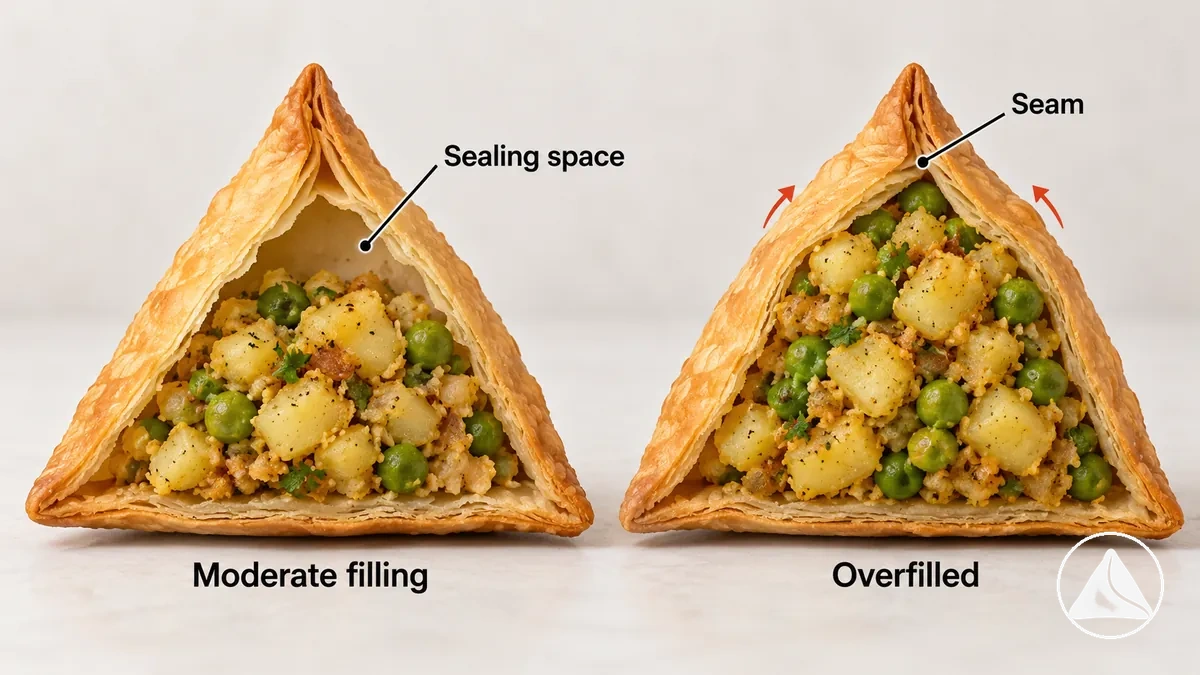
Overfilling concerns quantity; excess filling moisture concerns wetness. Either condition may occur without the other, or both may be present in one samosa.
A filling that extends close to the pastry edges, leaves little room for the edges to overlap, or visibly stretches the casing may be packed too tightly. Leave enough unfilled pastry for the edges to meet and overlap without pulling; forcing them together can compromise the seam.
Thin or Damaged Pastry Is More Likely to Split
Thin, uneven, stretched, or torn samosa pastry can create a local weak point where splitting begins during frying.
An area with reduced thickness or an existing tear may have less structural integrity than the surrounding pastry and give way as the samosa heats and expands.
The annotated illustration identifies a thin area and small surface tear, with the seam shown separately to clarify the failure location.
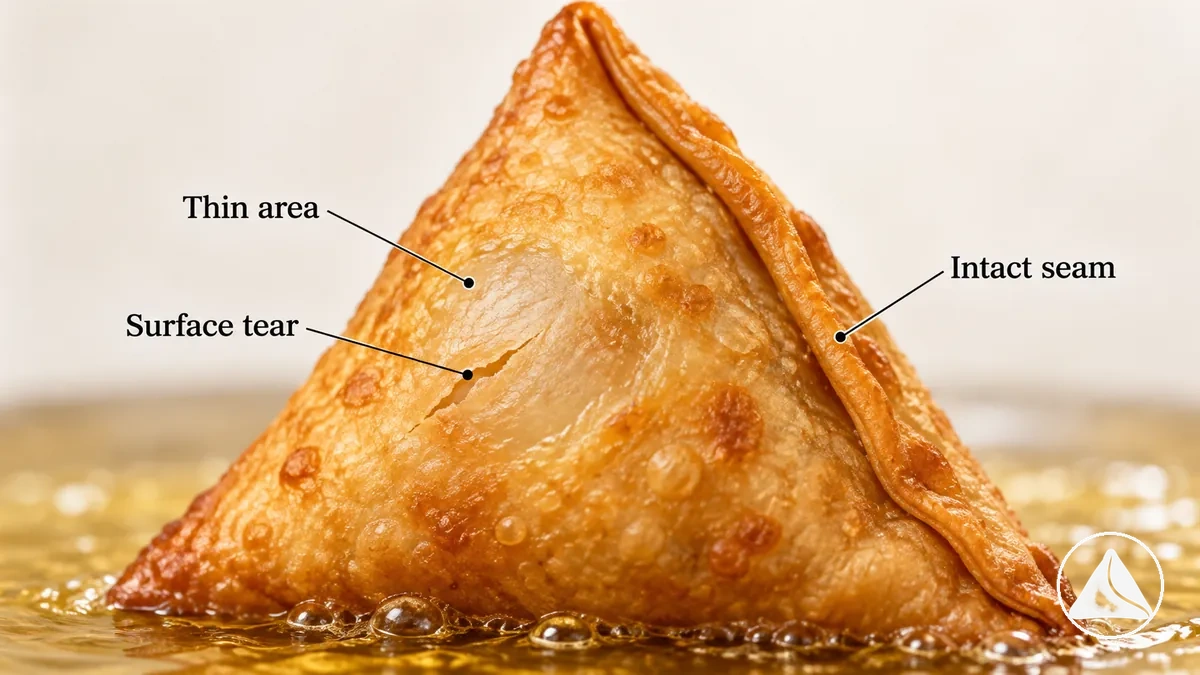
A seam separation follows the joined pastry edges, whereas a split through damaged pastry crosses the surface away from the seam.
Visible clues to a local pastry weakness include a noticeably thin patch or a small tear while the seam remains intact.
Excessive Frying Heat Can Intensify Puffing and Stress Weak Areas
Excessive frying heat can contribute to rapid puffing of samosa pastry and vigorous bubbling in the surrounding oil as moisture turns into steam.
Rapid expansion and changes at the pastry surface may add stress to an existing weak area, such as a poorly sealed seam or thin pastry patch, increasing the likelihood of opening or splitting during frying.
How to Identify the Cause in Your Samosas
To identify why a samosa opens or bursts during frying, start with the visible failure location, then check the condition most closely associated with that pattern.
Treat each visible signal as a starting point for interpretation rather than a confirmed diagnosis.
- Locate the first break. Check whether it follows the joined seam or crosses the pastry surface away from it.
- Assess moisture and quantity separately. Look for pooling liquid in the filling and insufficient room for the wrapper edges to overlap.
- Inspect the casing. Find any local thin patch, stretch mark or tear that matches where the split began.
- Compare frying behaviour. Note early, unusually rapid puffing or bubbling, but interpret it alongside the seal and pastry rather than as a diagnosis.
When several signals occur together, compare them with the failure location. A cause supported by several consistent clues is more plausible than one inferred from a single observation.
Check the Seal and Failure Point
The first diagnostic clue is the failure point relative to the samosa seam: whether the opening follows the joined edge or a tear crosses the surrounding pastry.
Use the following checks to identify where the failure began, assess seam continuity, and distinguish a possible sealing weakness from damage to the pastry itself.
- Check the seam: Does the opening follow the joined edge, with the pastry layers separating along their original connection?
- Find the starting point: Is there an isolated gap where the pastry edges appear poorly bonded or have pulled apart?
- Inspect away from the seam: Does a tear cross the pastry surface while the joined edge remains intact?
- Examine the surrounding pastry: Are there noticeably thin, stretched, or damaged areas near the failure point?
An opening that follows the joined edge, especially from a poorly bonded point, suggests that the seal deserves closer inspection.
A tear through a thin or damaged area away from the seam instead makes local pastry weakness a more plausible explanation.
Neither pattern identifies the cause with certainty, so compare the failure location with nearby pastry and seam conditions before deciding which weakness deserves further attention.
Check Filling Moisture and Quantity Together
Check filling moisture and filling quantity separately when diagnosing why a samosa opens during frying, because wet filling and overfilling can each contribute to seam failure or leakage.
The following checks distinguish excess free liquid from tightly packed filling, helping identify whether moisture, volume, or both are plausible contributors.
- Moisture check — visible free liquid: If liquid pools around the filling ingredients or collects at the bottom of the mixture, excess filling moisture may contribute to steam generation, pastry softening, or leakage during frying.
- Moisture check — no free liquid: If the filling is moist but holds together without releasing visible liquid, excess moisture is less strongly indicated, although its contribution cannot be ruled out from appearance alone.
- Quantity check — tightly packed filling: If the filling reaches close to the pastry edges and leaves little space for the seam to close, the samosa may be overfilled, increasing outward stress on the joined edges.
- Quantity check — available sealing space: If the filling sits comfortably inside the pastry with sufficient room for the edges to overlap, excessive filling quantity becomes a less plausible contributor to the opening.
A visibly wet filling with free liquid, but without overfilling, points more strongly towards moisture-related stress, while a comparatively dry but tightly packed filling makes excessive quantity a more plausible contributor.
When free liquid and reduced sealing space occur together, both conditions may contribute to the same opening or leakage pattern through different mechanisms.
Compare these observations with the condition of the seam to determine which variable has stronger supporting evidence rather than treating either cue as a confirmed cause.
Check Pastry Condition and Frying Heat
Check both the pastry condition and frying behaviour when a samosa splits, because a local weak point, excessive frying heat, or both may contribute to the failure.
Compare the location and condition of the damaged pastry with the timing of puffing, bubbling, and splitting to determine which factor has stronger supporting evidence.
- Pastry thickness and weak spots: Is there a noticeably thin area, uneven thickness, or stretched patch where the split begins? A split at a visibly weakened location suggests that reduced pastry integrity may be contributing to the failure.
- Tears and split location: Does a tear begin at an existing damaged area away from the seam? A split that follows a visible weak point makes local pastry damage a more plausible contributor than an opening caused primarily by seam separation.
- Puffing and bubbling: Does the samosa show rapid puffing or unusually vigorous bubbling soon after entering the oil? This behaviour may indicate additional stress associated with frying heat, but bubbling also occurs during normal frying and cannot independently establish excessive heat.
- Failure timing: Does the pastry split shortly after frying begins, particularly during rapid surface expansion? Early splitting alongside aggressive puffing may support a heat-related contribution, especially when the pastry already contains a thin or damaged area.
When a split begins at a visible thin area or tear, pastry condition provides stronger structural evidence, while rapid puffing and early failure without obvious pastry damage may warrant closer attention to frying behaviour.
If a weak point and vigorous expansion occur together, frying heat may have intensified stress on the already vulnerable pastry.
Interpret the failure timing, split location, and surrounding pastry condition together to identify the more plausible contributor without assuming a single definitive cause.
Correct the Identified Cause Before the Next Frying Batch
Correct the most plausible cause of samosa opening or bursting before the next frying batch, changing one suspected factor at a time where practical so you can compare the result.
The table maps each suspected cause to one targeted correction and an observable result to reassess, without replacing detailed preparation or frying instructions.
| Diagnosed Cause | Targeted Adjustment | What to Recheck |
|---|---|---|
| Weak seal | Keep filling off the pastry edges, provide enough overlap, and press the seam firmly. For pastry that needs an adhesive, use water or a thin flour-and-water paste suited to the wrapper. | Check whether the joined seam remains closed during frying or opens at the same failure point. |
| Excess filling moisture | Drain off or cook away visible free liquid, then allow hot filling to cool before enclosing it in pastry; the filling can remain moist without pooling liquid. | Check for moisture-related leakage and whether the pastry still opens near the filling. |
| Overfilling | Reduce the portion until the pastry edges can overlap and close comfortably without stretching the wrapper. | Check whether the seam closes comfortably and remains intact during frying. |
| Damaged pastry | Use a wrapper without visible tears or thin patches, and avoid stretching or nicking the pastry while folding. | Check whether splits still begin through the pastry surface away from the seam. |
| Excessive frying heat | Keep the oil heat controlled; use a thermometer when available, and adjust gradually if the casing puffs aggressively or browns unusually fast rather than judging heat by bubbles alone. | Check the intensity of bubbling, the timing of puffing, and whether early splitting still occurs. |
After the next batch, reassess the original failure pattern and the condition targeted by the correction.
If the samosas still open or split, compare the remaining evidence for seal weakness, filling moisture, overfilling, damaged pastry, and frying heat before making another major adjustment.
Changing one plausible contributor at a time helps reveal whether the adjustment is associated with improvement. If the opening persists, more than one condition may need correction.