
How to Reheat Samosas for Crisp Pastry
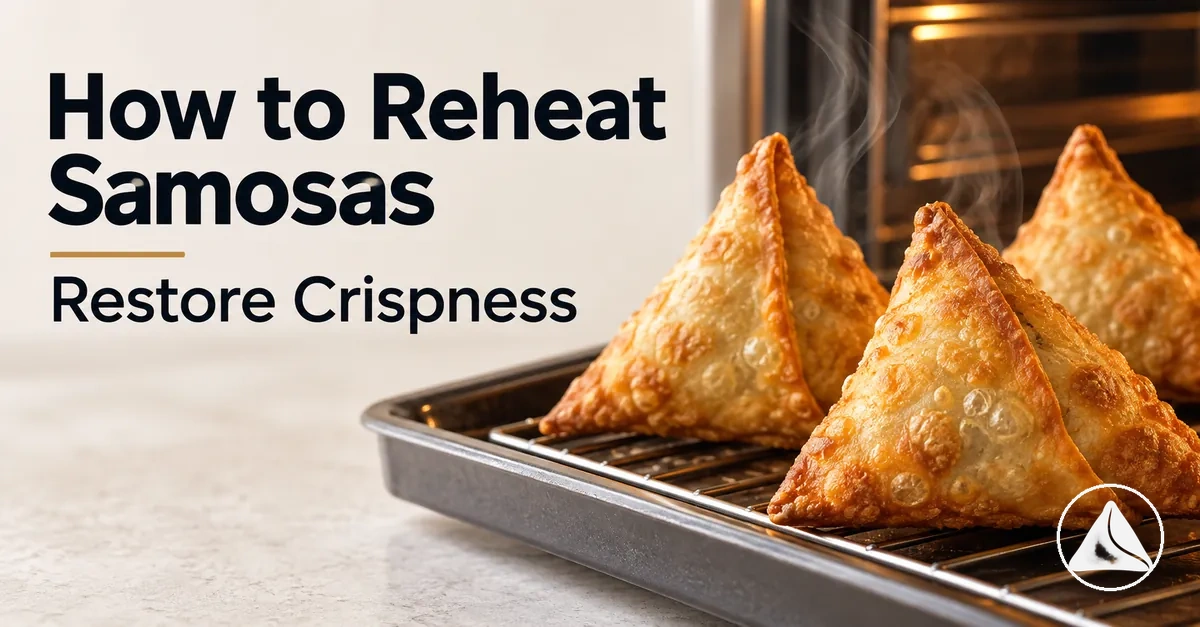
For previously cooked samosas, use dry heat to restore crisp pastry: an air fryer for a small batch or a preheated oven for a larger batch, with space between the pieces. Reheat until the filling is steaming hot throughout; a microwave is usually faster but can leave the pastry soft.
Reheating decision guide
Which method fits your samosas?
Choose the result you want, your batch size and whether the samosas are chilled or frozen. The guide suggests a method and the checks that matter more than a fixed timer.
Suggested method
Air fryer
Circulating dry heat helps crisp a small, well-spaced batch.
Read the air-fryer steps- Arrange cooked samosas in an uncrowded single layer in the air-fryer basket.
- Reheat with dry heat, turning or repositioning pieces if one side browns sooner.
- Check that the filling is steaming hot all the way through; stop when the pastry is crisp, not hard.
If the surface browns before the centre is hot, reduce the heat where possible and recheck in short intervals.
These are conditional method suggestions, not guaranteed times or food-safety thresholds. They apply to previously cooked samosas; follow any specific product and appliance instructions.
Samosa size, starting temperature, surface moisture, quantity and appliance strength all affect reheating. The method-specific examples below are starting points, not universal timings.
Table of Contents
Prepare Leftover Samosas for Even Reheating
Even reheating begins by checking the leftover samosas' starting condition before applying heat.
Starting temperature, size, surface moisture, quantity, and spacing can change how evenly the filling warms and how the pastry texture develops.
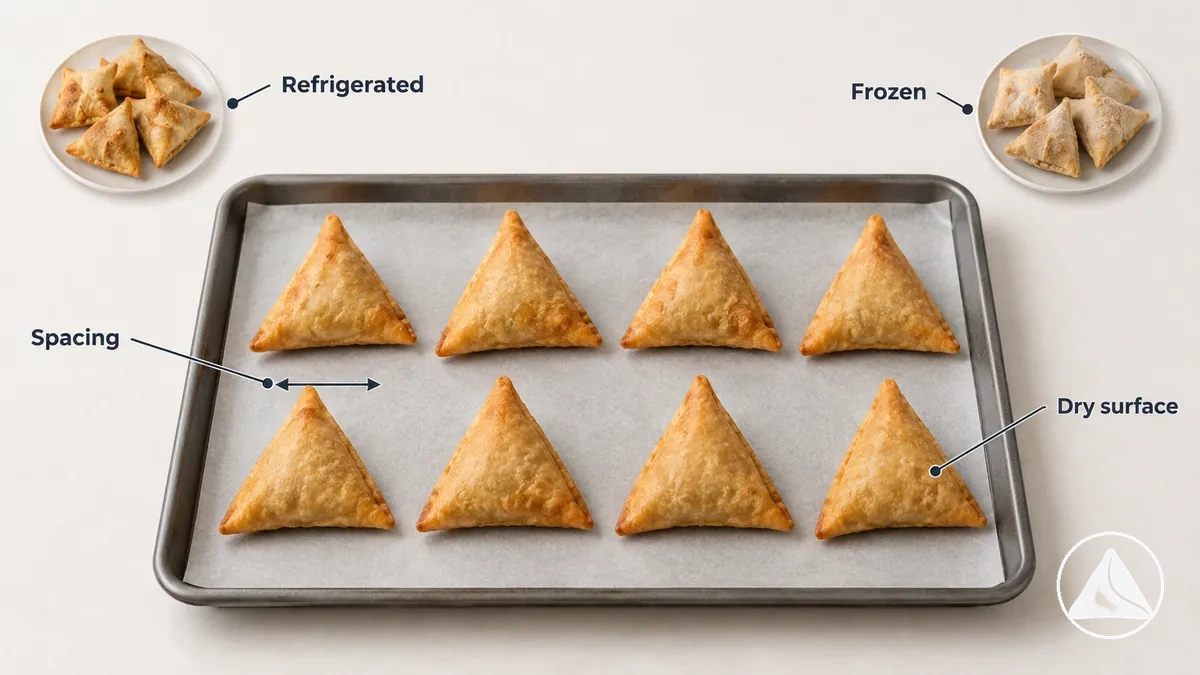
Refrigerated samosas start warmer than frozen samosas, so a frozen starting state generally requires more reheating time under otherwise similar conditions.
A single chilled samosa also has more exposed space around it than a crowded batch, while close spacing and a larger quantity can restrict heat circulation around individual pieces.
Check both the starting condition and batch arrangement before choosing a reheating method:
- Starting temperature: identify whether the leftover samosas are refrigerated or frozen because the colder starting state changes the heating requirement.
- Size: larger or thicker samosas may need more time for the centre to warm than smaller pieces under the same conditions.
- Surface moisture: if moisture is visible on the pastry, account for it because a damp surface can work against a crisp texture.
- Spacing: arrange samosas with space around individual pieces when the chosen appliance relies on circulating heat.
- Quantity: a crowded batch can reduce heat exposure around individual samosas and may increase reheating time compared with one or two pieces.
- Appliance readiness: confirm that the chosen appliance can accommodate the batch without forcing the samosas into an unnecessarily crowded arrangement.
Choose a Reheating Method for Crispness and Even Heating
Choose the reheating method according to the desired balance of crispness, heating speed, batch capacity, and even heating.
Oven and air-fryer reheating use dry heat and tend to support a crisper exterior, while microwave reheating is usually faster but may leave the pastry softer.
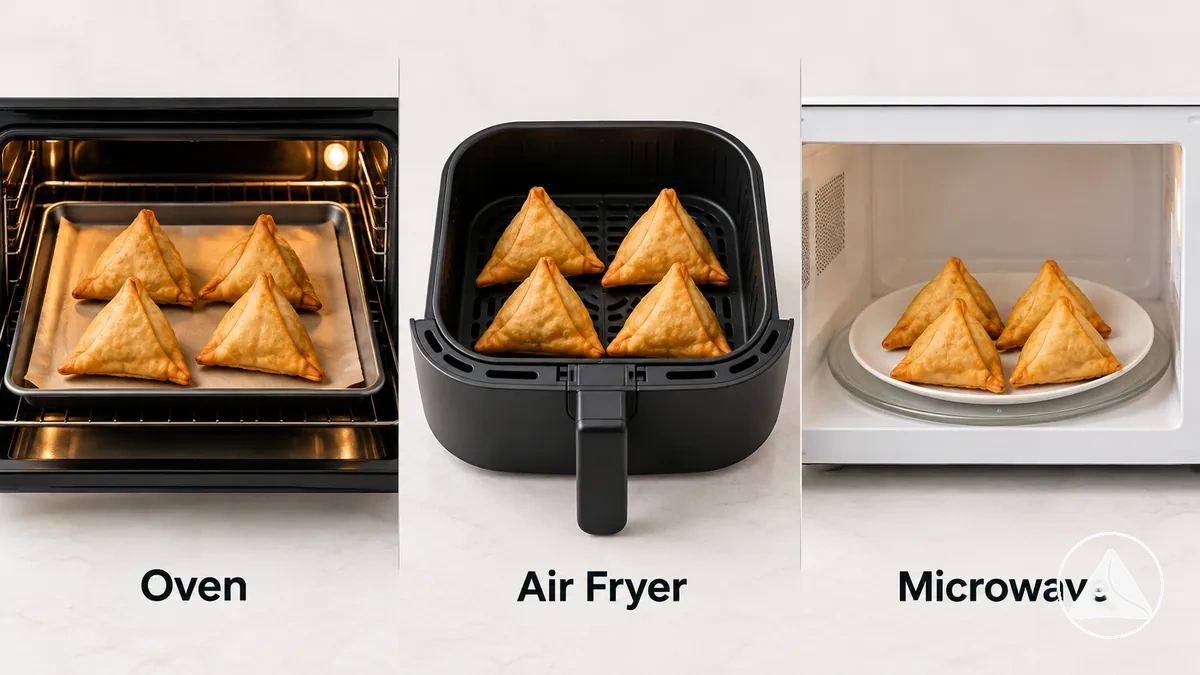
The three methods can be compared using the same criteria: crispness potential, speed, batch capacity, and their main texture or heating limitation.
Actual performance still depends on the appliance, samosa size, starting temperature, and quantity, so these are conditional method-level trade-offs rather than fixed outcomes.
| Method | Crispness Potential | Speed | Batch Capacity | Main Limitation |
|---|---|---|---|---|
| Oven | Generally suited to restoring a crisp exterior with dry heat | Usually slower because preheating and heating can take longer | Can accommodate multiple spaced samosas when tray space allows | Prolonged heating can dry the pastry or filling |
| Air fryer | Generally suited to crispness because circulating dry heat reaches exposed pastry surfaces | Often quicker for smaller batches | Limited by basket size and the need to avoid crowding | Crowding can reduce airflow, while excessive heating can dry the pastry |
| Microwave | Less suited to restoring a crisp exterior because the pastry may soften | Usually the quickest of the three methods for short reheating | Suitable capacity depends on cavity size and how many samosas can be arranged without excessive overlap | The pastry may become soft, and heating may be less even |
Method choice therefore depends on the intended trade-off: an oven can suit larger batches and crispness-focused reheating, an air fryer can suit smaller batches where airflow and crispness matter, and a microwave can suit situations where speed is the main priority despite a greater chance of soft pastry.
Reheat Samosas in the Oven
Reheat cooked samosas in a preheated oven with dry heat and enough spacing for the pastry to crisp while the centre warms.
Big Mum's Samosas specifies 180°C for 6–8 minutes for its own samosas. Treat this as a product-specific starting reference, not a universal time or temperature for different sizes or frozen leftovers.
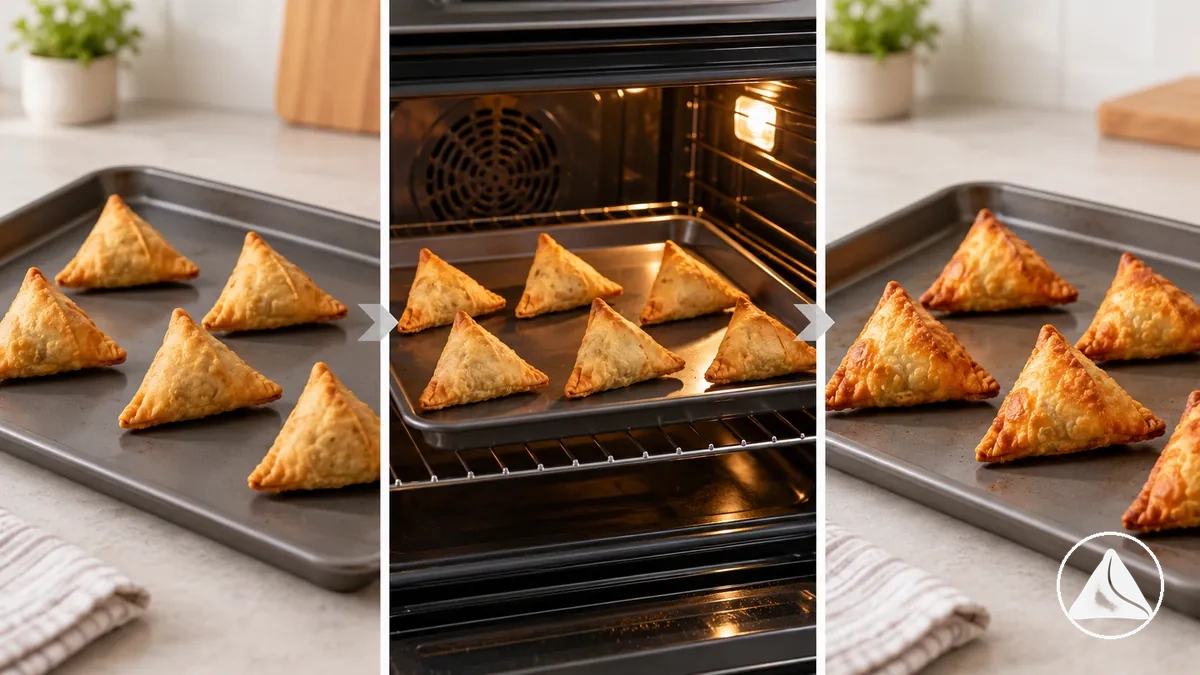
- Preheat the oven. A temperature around 180°C can serve as a starting point where appropriate, but oven performance and the samosas' starting condition can require adjustment.
- Arrange the samosas. Place the cooked samosas on a tray with spacing between individual pieces so exposed pastry surfaces receive dry heat.
- Heat the batch. For the product-specific reference above, Big Mum's Samosas specifies 6–8 minutes; larger, colder, or more numerous samosas may require different reheating time.
- Turn or reposition when useful. If one side is heating or crisping faster because of tray contact or oven hot spots, turn or reposition the samosas partway through reheating.
- Check before removal. Remove the samosas when the pastry has a crisp exterior and the centre is heated through; exterior colour alone does not verify that the filling is sufficiently warm.
Reheat Samosas in an Air Fryer
Reheat cooked samosas in an air fryer in an uncrowded single layer so circulating dry heat can move around the pastry.
SecondRecipe uses 180°C (355°F) for about 5 minutes after a 1–2 minute preheat as an example starting approach. Size, starting temperature, basket crowding, airflow and appliance strength can all change the time required.
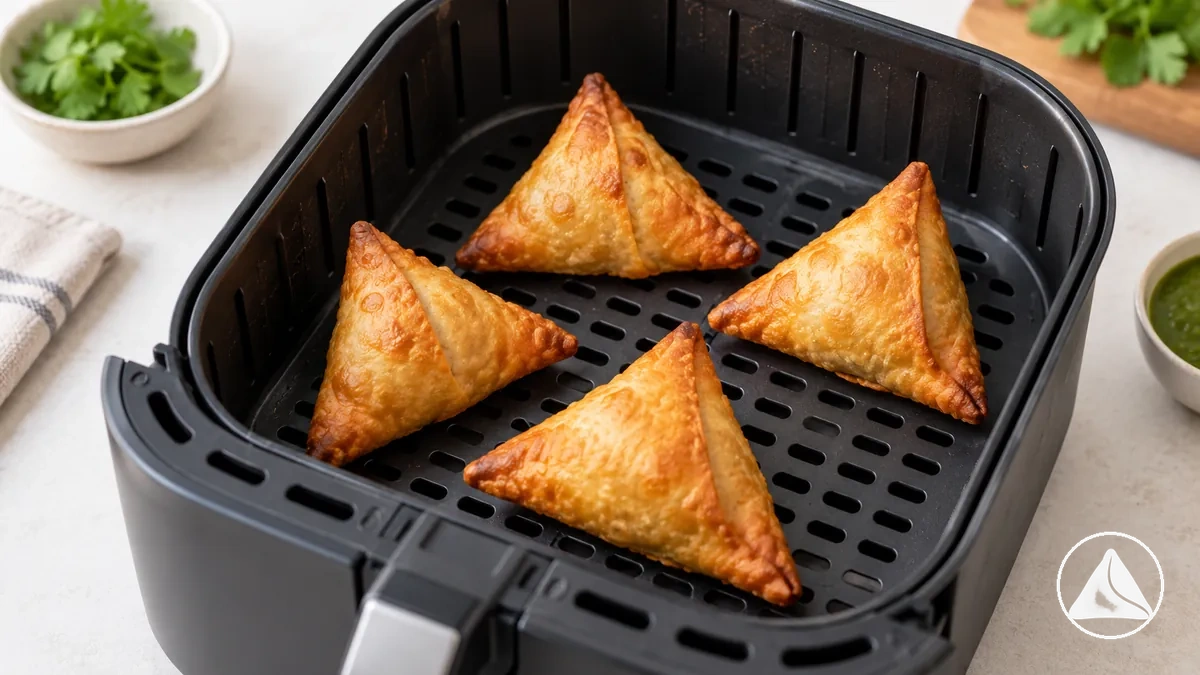
- Preheat when appropriate. If the air fryer benefits from preheating, follow the appliance guidance or use the qualified starting approach above rather than assuming every model needs the same setup.
- Arrange the samosas. Place the cooked samosas in the basket in a single layer with spacing between pieces so unnecessary crowding does not restrict airflow.
- Reheat the batch. SecondRecipe uses about 5 minutes at 180°C (355°F) for leftover samosas; begin checking around that point and adjust when the samosas are larger, colder, more crowded, or heated in a stronger or weaker appliance.
- Turn or reposition when useful. If basket contact or uneven airflow makes one side crisp faster, turn or reposition the samosas partway through reheating.
- Check before stopping. Stop reheating when the pastry has regained crispness and the centre is heated through rather than relying only on exterior colour.
Reheat Samosas in the Microwave
A standard microwave can reheat cooked samosas quickly, but microwave-only reheating may soften the pastry: steam can remain near the surface instead of escaping as readily as it does with dry heat.
Place the samosas on a microwave-safe plate and use short intervals with checks between them; microwave power, samosa size, quantity, and starting temperature affect how many intervals are needed.
Combination or convection microwave modes use different heating functions and should not be treated as standard microwave-only reheating.
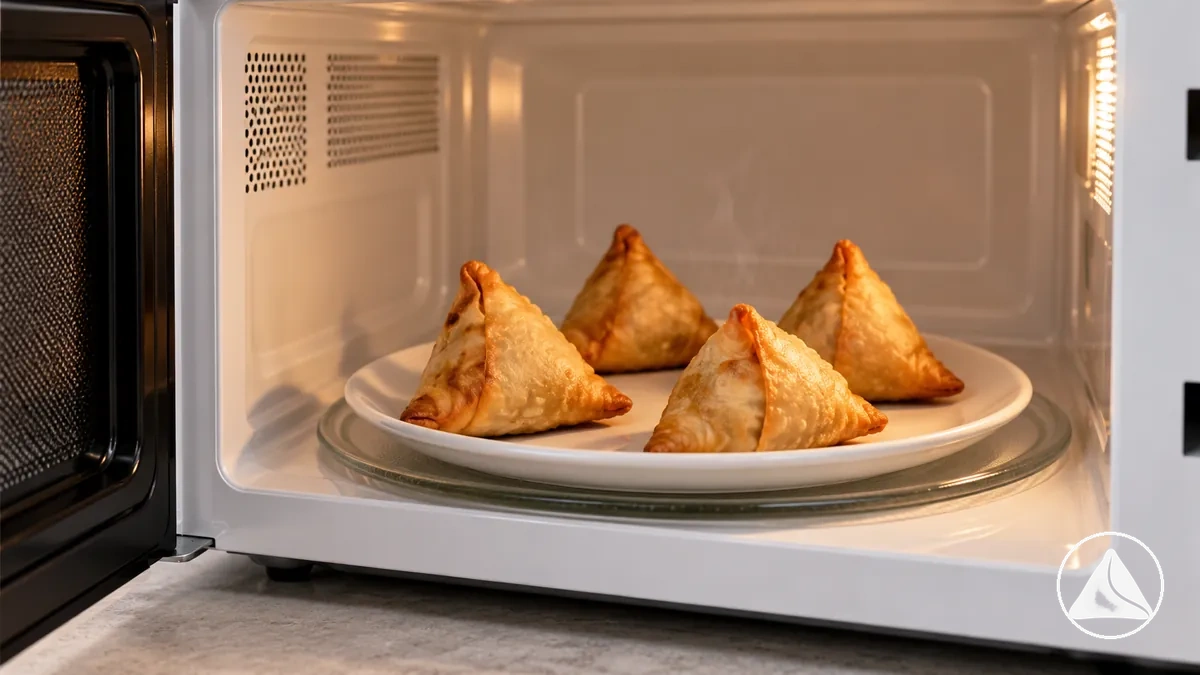
- Arrange the samosas. Place a small batch on a microwave-safe plate without stacking the pieces so each samosa can be checked easily during reheating.
- Heat in short intervals. Use brief bursts rather than one long uninterrupted cycle, adjusting the number of intervals according to microwave power, portion size, and starting temperature.
- Check between intervals. Check whether the filling and centre are heated sufficiently after each interval, and reposition the samosas if some pieces are warming faster than others.
- Repeat and stop. Continue with short intervals only until the filling and centre are heated through. Standard microwave reheating may leave the pastry softer because retained steam can reduce crispness.
Adjust Reheating Time and Temperature Without Drying Out the Samosas
Adjust reheating time and temperature together according to the selected method, appliance intensity, samosa size, starting temperature, batch size, and desired crispness.
Colder or larger samosas generally need more time for the centre to heat through. If the pastry is browning before the centre is hot, lower the temperature where the method permits and check in shorter intervals rather than raising the heat and drying the pastry.
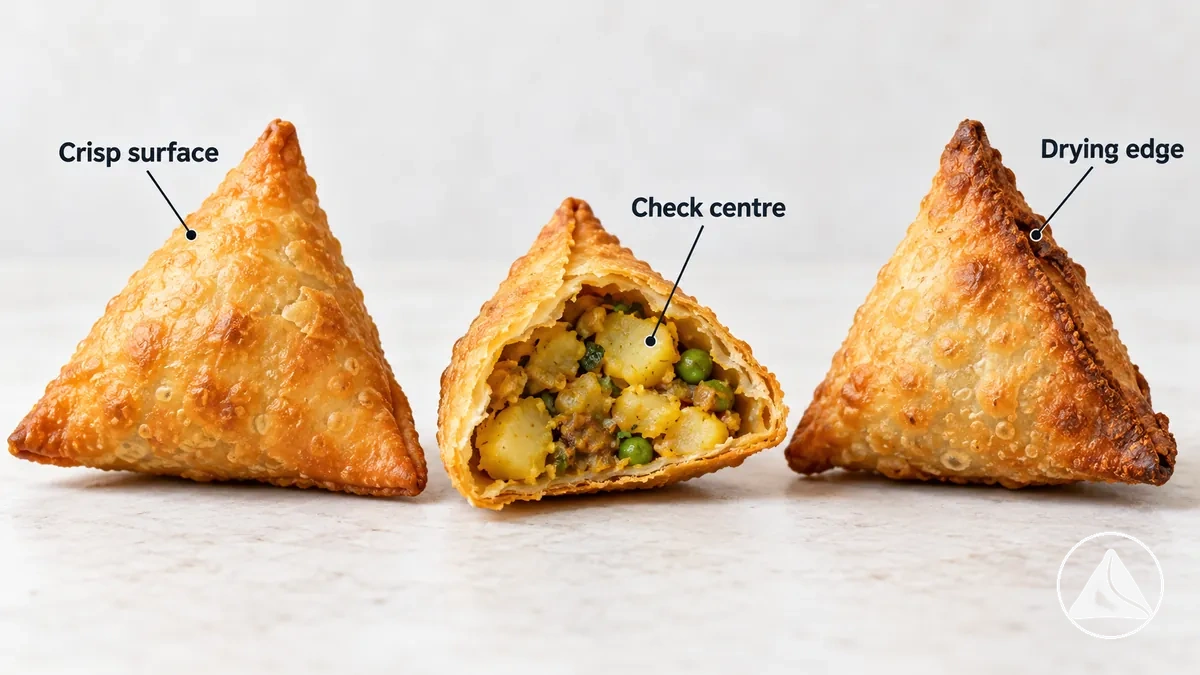
There is no single reheating time or temperature that suits every batch. Begin with guidance for the chosen appliance and the samosas' chilled or frozen condition, then check the centre and extend heating only as needed; do not assume a chilled-leftover example also applies to frozen pieces.
Keep chilled and frozen samosas distinct, and use size, batch size, starting temperature, and appliance intensity to determine whether to extend time, reduce heat, or increase checking frequency.
| Variable | Condition | Possible Adjustment | Stopping Cue |
|---|---|---|---|
| Samosa size | Larger or thicker pieces need more centre heating than smaller pieces under otherwise similar conditions | Extend reheating time cautiously and check the centre before adding further exposure | Centre heated through while the pastry remains crisp rather than hard |
| Starting temperature | Colder samosas need more heating than warmer leftovers, and frozen samosas should not be treated as equivalent to chilled leftovers | Use guidance appropriate to the actual starting state and extend time only as needed | Filling heated through without excessive surface drying |
| Batch size | A larger batch may heat less evenly or more slowly when spacing or circulation is reduced | Check more frequently and extend exposure only where additional centre heating is needed | Individual samosas are heated through before the earliest-crisping pieces become dry |
| Appliance intensity | The surface crisps or darkens faster than the centre heats | Reduce temperature or heat level where the method allows, shorten exposure, or check sooner | Crisp exterior and heated centre before the pastry becomes hard or excessively dry |
Use the combined texture and heating result as the stopping cue rather than the clock alone: the centre should be heated through and the surface should reach the desired crispness without becoming hard.
Stronger heat may crisp the surface sooner, but continued exposure can increase drying, so reduce or stop the heat once additional reheating is no longer improving centre heating enough to justify further exposure.
Check That the Pastry Is Crisp and the Filling Is Heated Through
Successful reheating requires two separate checks: pastry that is crisp rather than brittle, and filling that is steaming hot throughout. Browning and elapsed time alone cannot confirm even heating.
Two-part readiness check
1. Pastry exterior
- Target
- Dry, crisp pastry that is not hard or brittle.
- Check
- A damp or soft surface may need brief additional dry heat; pronounced hardness or excessive browning suggests over-drying.
- Next step
- Stop if the shell is crisp and the centre is hot. If the shell is still soft, use short additional dry-heat exposure and check again.
2. Filling centre
- Target
- Filling that is steaming hot throughout, without a noticeably cool centre.
- Check
- Inspect the thickest piece, and compare pieces from different positions in a batch. A crisp shell does not confirm an evenly heated filling.
- Next step
- If any centre is still cool, reposition when useful, heat again briefly, then recheck before serving.
Texture is not a food-safety measurement. Where a specific core temperature is required, check with a food thermometer and follow the relevant food-safety guidance.
Fix Samosas That Turn Soggy, Dry, or Heat Unevenly
Reheated samosas can turn soggy, dry, or heat unevenly for different reasons, so one symptom alone does not prove a single cause.
Diagnose the result by separating the visible or tactile symptom from its possible reheating cause, then use a quick check before choosing a correction.
Use the symptom to narrow the possibilities, then check the reheating conditions before correcting the batch.
The comparison below separates sogginess, dryness, and uneven heating into possible causes, observable checks, and corrective directions without assuming that one symptom confirms one cause.
| Symptom | Possible Reheating Cause | Check | Corrective Direction |
|---|---|---|---|
| Soggy or soft pastry | Trapped steam, crowding, a wet surface, or a reheating method that retains more surface moisture can contribute to softness | Check whether the pastry surface is damp and whether the samosas were crowded or exposed mainly to moist reheating conditions | Increase spacing where airflow is used, allow surface moisture to escape, and continue reheating briefly with an appropriate dry-heat method if the samosas still need crisping |
| Dry or hard pastry | Excessive heat or prolonged exposure can remove too much moisture from the pastry | Check for a hard, brittle, or overly browned exterior, especially when the filling is already heated through | Stop further heating or shorten the next reheating interval; where the method allows adjustment, reduce heat exposure rather than extending it |
| Uneven heating or a cold centre | Different samosa sizes, high batch density, a colder starting temperature, or insufficient checking or turning can contribute to uneven heating | Check the centre of more than one samosa and compare pieces from different positions in the batch | Reposition or turn the samosas where useful and apply brief additional heating to the pieces that still have a cool centre |
A crisp exterior with a cold centre is an uneven-heating problem, not a reason to keep browning the shell at higher heat.
Recheck the centre and use brief additional heating or repositioning as appropriate, while avoiding unnecessary extra exposure to an exterior that is already crisp; by contrast, soft pastry calls for a correction aimed at surface moisture and crispness rather than centre heating alone.